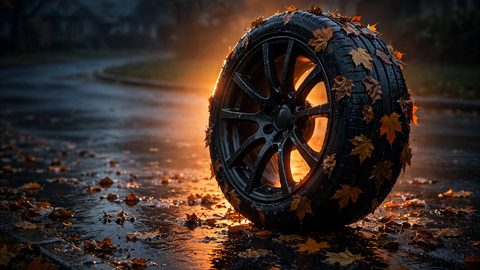

Toronto gets one more mild weekend before winter stops hinting. Friday sits near 14°C with showers, Saturday is mostly cloudy near 11°C, and Sunday is partly cloudy near 12°C with stronger west winds. Then the forecast steps down hard: about 10°C on Wednesday, a high near 5°C on Thursday, November 12, and the first below-zero night of the season right behind it, near −1°C.
That sequence is exactly why this weekend matters. Cold rain, wet roads and a sharp temperature drop do different damage than a snowstorm does, and they do it quietly. This is the dry, daylight window to run a short tire checklist at home — pressure, tread, and whether the right tires are on the car at all — before the first freeze turns small gaps into morning problems.
Why cold rain is its own test
A lot of drivers treat rain in November as a non-event: no snow, no ice, nothing to worry about. The tire sees it differently. Standing water has to go somewhere. The grooves in your tread exist to move water, slush and snow out from under the contact patch so the rubber itself can grip the road. As tread wears down, that water has less room to escape, stopping distances grow on wet pavement, and the risk of hydroplaning — the tire riding up on a film of water instead of cutting through it — rises with speed.
Temperature makes the second half of the problem. All-season compounds start to stiffen as temperatures fall toward and below 7°C. A stiff tire does not conform to the road the way a flexible one does, so cold, wet grip fades even on a road that looks merely damp. That is the whole logic of the 7°C rule: it is about rubber, not snowfall. This weekend you will drive through both halves at once — rain and showers on Friday and Saturday, then overnight lows sliding toward the range where all-season rubber gives up its best work.
Check 1: Pressure, checked cold, to the placard
Start with the simplest number on the car. Tire pressure falls as air cools: roughly 1 psi for every 6°C (10°F) drop in temperature. A set filled correctly during the warm spell earlier this month can be several pounds low by the time Thursday night hits −1°C, and low pressure costs you wet grip, steering precision and even wear, and it can light the TPMS warning on the coldest morning of the week.
Do it properly. Check pressure in the morning, before driving, because driving warms the air inside the tire and inflates the reading. Use the figure on the driver’s door placard — the vehicle manufacturer’s cold inflation pressure — never the maximum pressure molded into the tire sidewall. Check all four, and the spare if your car carries one. If the TPMS light has already come on during a cold snap, treat it as information, not an annoyance: measure first, top up to placard, and only chase a sensor if the light stays on with correct pressures.
Check 2: Tread depth, honestly measured
Next, look at what is left of the tread. For winter use, the working line is 4 mm. Transport Canada advises against using tires worn close to 4 mm (5/32 inch) on snow-covered roads, and the reason shows up in the rain first: below that depth, the grooves move far less water and snow, and wet and slushy grip falls off a cliff. A tire can be legal and still be finished as a winter tire. Those are different bars, and November is when the difference matters.
You do not need special tools to get a first read. Look for the raised wear bars in the main grooves — tread flush with those bars means the tire is done. Check across the width and around the tire, not in one convenient spot, and look for uneven wear, cracks, bulges and damage while you are down there. If any winter tire in the set is at or under that 4 mm neighbourhood, plan its replacement now, while sizes are on shelves, rather than after the first freeze makes every shop in the GTA busy at once. The tire and wheel shop lists what is available by size, and fitment gets verified for your exact vehicle before anything ships.
Check 3: The right tires on the car, not in the garage
The third check is the bluntest one. A perfect set of winter tires stored in the garage does nothing for a car still commuting on all-seasons. With Thursday’s high near 5°C and the first sub-zero night behind it, next week is the week the swap stops being early and starts being late. If your winters are on rims, a seasonal swap is quick. If they need mounting and precision computer balancing on the same rims, that is a changeover, and it still beats discovering the gap on an icy morning.
Electric cars get no exemption from any of this. Cold costs an EV range and regenerative braking feel, but the contact patch obeys the same physics, and Tesla drivers should be on a proper winter set with the correct load rating. Complete tire and wheel packages include free mobile installation, and Tesla packages include pre-programmed Bluetooth TPMS sensors, so there is no second trip and no sensor guesswork. If cost is the hesitation, sets of four can carry manufacturer rebates — check the current offers on tire rebates before you decide.
Driving the weekend itself
Until the checks are done, drive the weather you have. Friday’s showers and the weekend’s gusty west winds — forecast up to about 26 km/h on Sunday — mean wet leaves, pooled water on rutted lanes, and longer stops than the same road demands in July. Leave more following distance than dry-road habit suggests, brake earlier and gentler, and be careful through standing water on the Gardiner, the DVP and the 401 collectors, where hydroplaning starts at highway speed on worn tread. On Sunday night the temperature slide begins; by later next week, treat bridges and overpasses as the first surfaces to freeze, for the reasons laid out in why overpasses freeze first.
The 15-minute weekend routine
Here is the whole checklist in one pass, in daylight, before the cold arrives. One: check all four pressures cold and set them to the door placard. Two: read the tread on every tire, look for wear bars, cracks and uneven wear, and note anything near 4 mm. Three: confirm the winter set is either on the car or booked to go on this week — our seasonal tire changeover page explains the on-rim and off-rim options. Four: top up winter washer fluid, check the wiper blades streak, and make sure every light works now that Toronto’s sunset is at 5:00 p.m. Five: put the scraper and brush back in the car. None of it is glamorous. All of it is cheaper and calmer done on a mild Saturday than discovered at −1°C before work.
Frequently Asked Questions
When is Toronto’s first freeze expected?
The forecast published on Friday, November 6 puts Thursday, November 12 at a high near 5°C with an overnight low near −1°C — the first below-zero night of the season in that outlook, after a mild weekend near 11 to 14°C. Forecasts shift, but the direction is clear: use the mild weekend to prepare.
How much does tire pressure drop when it gets cold?
About 1 psi for every 6°C (10°F) drop in temperature. A set filled during a mild spell can be several psi low after a sharp cold snap, which is often what triggers the TPMS light on the first cold morning. Check pressures cold, in the morning, and set them to the driver’s door placard figure.
How much tread do winter tires need to still work?
Treat 4 mm as the working minimum for winter. Transport Canada advises against using tires worn close to 4 mm (5/32 inch) on snow-covered roads, because the grooves can no longer move enough water, slush and snow to keep the rubber gripping. A tire can pass a legal minimum and still be finished as a winter tire.
Is cold rain really worse than light snow for driving?
It catches more drivers out. Rain at near-freezing temperatures combines standing water, hydroplaning risk on worn tread, and all-season rubber stiffening below 7°C — while the road still looks harmless. Light snow at least announces itself. Slow down, leave more room, and make sure the tread and pressure checks are done.
The bottom line
This weekend is the last easy one: mild, mostly dry between showers, and in daylight you can use. Next week brings a 5°C high and the first sub-zero night. Fifteen minutes with a pressure gauge and an honest look at your tread is the difference between driving into that freeze ready and finding out what your tires cannot do on the coldest morning of the season.
Need the swap or a full package sorted before Thursday? Shop the tire and wheel shop, see how mobile tire service works, and read common answers on the FAQs page. Tesla drivers can start on the Tesla and EV tire service page.
Book online: sparkyx.ca/book
Call or text: (647) 819-0490
Sparky X Mobile Tire Shop — fully mobile across Toronto, the GTA, Durham and York. Our office is at 60 Hoile Drive in Ajax; all service happens at your home or workplace. We come to you.