
Toronto is heading for about 21°C today, in late October, with a daytime record in reach. The city still has not recorded a freezing temperature this fall — the average date for the first 0°C reading is around October 13, and it has come and gone. Friday night drops to about 4°C, then the mild pattern hangs around into November.
Weather like this splits GTA drivers into two camps, and both of them ask us the same question in the same week. The drivers who already swapped ask: “Am I burning up my winter tires driving on them in this heat?” The drivers who have not swapped yet ask: “My winters are a few years old — are they even still good?”
Both questions are really one question: how long does a set of winter tires actually last, and what decides it? Here is the honest answer, the two clocks every winter set is running on, and the habits that separate a four-season set from a six-season set.
The honest answer: four to six seasons
For most GTA drivers, a quality set of winter tires lasts four to six winter seasons. That range is wide because a “season” is not a unit of wear. Your tires do not count birthdays in the garage. They count kilometres, heat cycles, and how they were treated in between.
A set that spends five months a year on a car that commutes across the 401 every day lives a much harder life than a set on a second car that mostly does school runs and grocery trips in Durham. Aggressive acceleration and braking wear any tire faster, and winter tires give up their rubber more easily than most — the soft, cold-gripping compound that keeps them flexible at -20°C is, by design, easier to wear away.
So treat four to six seasons as the planning number, not a promise. What actually retires a winter set is almost never the calendar alone. It is one of two clocks running out first: tread depth, or age.
Clock one: tread depth, and the 4 mm rule
A winter tire does its work with depth. The deep grooves and channels clear slush and bite into snow; the tread blocks need room to flex and grip. As the tire wears, that machinery gets shallower, and winter performance falls off well before the tire looks “bald.”
This is the part most drivers miss: the legal end of a tire and the useful end of a winter tire are two very different numbers. Tires carry built-in wear bars that show at about 1.6 mm of remaining tread — at that point the tire must be replaced, full stop. But Transport Canada advises against using tires worn close to 4 mm (about 5/32″) on snow-covered roads. In other words, a winter tire can still be legal and already be done as a winter tire. If your winters are approaching 4 mm, this is their last season, and the time to plan the replacement is now — during changeover season, while your size is on shelves — not after the first storm.
You do not need a gauge to get a first read, though a tread depth gauge is the precise tool. Use the toonie test: push a toonie into a main tread groove at the most worn spot, polar bear facing up with the paws toward the tread. If the tread reaches the bear’s paws, you have plenty of life. If it only covers the silver outer ring, the tire is roughly half worn. If the tread reaches only about halfway up the lower letters, it is replacement time. Check several spots across the width of every tire, and let the worst reading win — a tire is only as good as its most worn groove.
Clock two: age, whether the tread shows it or not
Rubber ages even when a tire barely turns. Heat, sunlight, and time slowly harden the compound, and a hardened winter tire loses the flexibility that is its whole reason to exist. A six-year-old winter tire with respectable tread can grip noticeably worse on ice than it did when it was fresh, and fine cracks in the sidewall or between tread blocks are the visible warning.
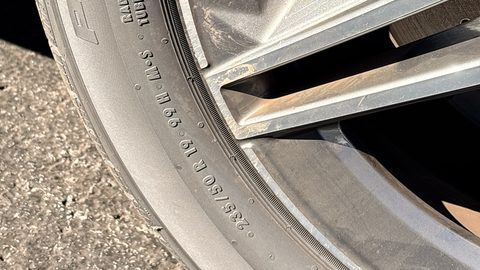
The general guidance across the industry is to retire tires at around six years of age regardless of how the tread looks. The manufacturing week and year are stamped in the DOT code on the sidewall — we explained how to read it in our guide to older DOT dates on new tires. When we pull a stored set out at changeover time, age is one of the first things we check, for exactly the reasons we covered in are your stored winter tires still safe to use?
The habits that kill a set early
Running them deep into warm weather. Winter compound wears fastest exactly when it is doing no good — on warm, dry pavement. A day like today at 21°C is fine; a habit of leaving winters on into May is not. Swap on temperature, not on snowfall: sustained averages around 7°C are the trigger in both directions, as we laid out in when to switch to winter tires in Ontario.
Ignoring pressure. Tire pressure falls by roughly 1 psi for every 5°C drop in temperature, so a set filled on a mild October afternoon can be running low by the first cold snap. Underinflated tires wear their shoulders, handle sloppily, and waste fuel or range; overinflated tires wear the centre and shrink the contact patch. Either way, the set dies early. The correct number is the one on the driver’s door placard, checked cold, at least once a month — never the maximum molded into the sidewall.
Never rotating. On a front-wheel-drive car the front tires steer, drive, and do most of the braking, and they wear far faster than the rears. Skip rotations and you retire two tires while the other two still have life — then you are buying in pairs and running a mismatched set. A seasonal changeover is a built-in rotation opportunity: mark each wheel’s position when it comes off, and put it on a different corner next season.
Riding on damage. One-sided wear, a feathered edge, or a wear pattern that appeared over a single season is the tire reporting a problem — alignment, a worn suspension part, or chronic pressure neglect. A bulge, deep cut, or crack in the sidewall is not a wear item at all: that tire is finished, whatever its tread says.
The habits that stretch a set to six seasons
None of this is expensive or complicated. Swap on the 7°C rule in both directions so the soft compound only works in its season. Check pressures monthly, cold, against the door placard. Rotate at every changeover, and have the set balanced with precision computer balancing when a changeover calls for it, so small imbalances do not chew one spot of tread all winter.
Store the off-season set like you want it to last: washed clean of salt and brake dust, fully dry, bagged, and kept in a cool, dark, dry place away from furnaces and direct sun. Tires mounted on rims store stacked on their sides; unmounted tires store standing upright. And drive them like rubber costs money — because it does. Smooth inputs on cold pavement are worth real tread over a five-month season.
Replace, do not reinstall, when you see this
Changeover day is inspection day. Before a set goes back on for another winter, it fails the season if any tire shows tread at or below the 4 mm neighbourhood, sidewall cracks, bulges or deep cuts, wear down to the cords, uneven wear you cannot explain, or a DOT date that puts it at about six years old. Repeated slow pressure loss with no nail found belongs on the list too.
When one tire fails, the default answer is a full set of four. Balanced grip at all four corners is what keeps a car predictable in an emergency stop on slush; mixing a fresh pair with a tired pair gives you a car that grips at one end and lets go at the other. You can search live pricing by size in our tire and wheel shop, and complete tire and wheel packages include free mobile installation at your home or workplace — Tesla packages include pre-programmed Bluetooth TPMS sensors.
Frequently Asked Questions
How long do winter tires last in Ontario?
Most GTA drivers get four to six seasons from a set of winter tires. Where a set lands in that range depends on winter mileage, driving style, pressure and rotation habits, storage, and whether the tires are removed promptly when warm weather returns. Tread depth and age retire a set long before the calendar alone does.
At what tread depth should winter tires be replaced?
Plan to replace winter tires as they approach 4 mm (about 5/32″) of remaining tread. Transport Canada advises against using tires worn close to 4 mm on snow-covered roads, because winter grip falls off well before the legal wear-bar limit of about 1.6 mm. Use a tread depth gauge for a precise reading, or the toonie test for a quick first check.
Can winter tires be too old even if the tread looks good?
Yes. Rubber hardens with age, heat, and sunlight, so an older winter tire loses the flexibility it needs to grip ice even when its tread depth still measures well. The industry guidance is to retire tires at around six years of age regardless of tread. The manufacturing date is in the DOT code on the sidewall, and cracks in the sidewall or between tread blocks are a warning sign.
Does rotating winter tires really extend their life?
Yes. Front tires on a front-wheel-drive vehicle wear much faster than the rears because they steer, drive, and do most of the braking. Rotating evens that wear across all four tires, so the whole set reaches the end of its tread life together instead of two tires retiring early. A seasonal changeover is the natural time to do it — mark each wheel position when the set comes off.
Make this set earn its seasons
A winter set is a four-to-six-season investment, and the difference between the short end and the long end of that range is mostly habits: swap timing, pressure, rotation, storage. This mild week is the perfect time to use them — check the set before the cold arrives, while there is no storm in the forecast and no queue anywhere.
If your winters are near 4 mm, near six years old, or you are not sure either way, book a seasonal changeover and we will measure and inspect the set at your home or workplace before it goes on: book mobile tire service. The full list of what we do is on our services page, and common questions are collected on the FAQs page.
Book online: sparkyx.ca/mobile-tire-service-bookings
Call or text: (647) 819-0490
Sparky X Mobile Tire Shop — fully mobile across Toronto, the GTA, Durham and York. Our office is at 60 Hoile Drive in Ajax; all service happens at your home or workplace. We come to you.