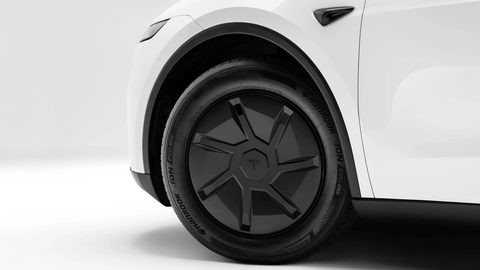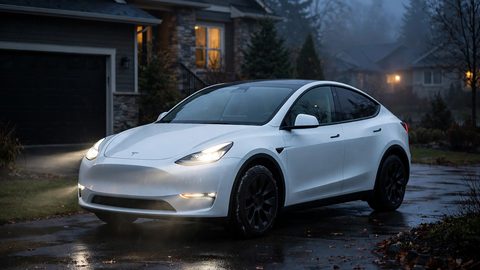

It usually starts with a message the morning after install day. The winter package went on yesterday — new wheels, new winter tires, new TPMS sensors — and this morning the tire pressure light is on, and one corner of the car shows no pressure reading at all. Did something get installed wrong?
Almost always, no. What you are looking at is a sensor that has not woken up yet. Tesla's tire pressure sensors work differently from the ones in most cars, and a brand-new sensor sometimes takes its time introducing itself to the car. Here is what is happening, what is normal, and where the line is — because there is a line, and past it, we come back and replace the sensor at no cost to you.
Tesla TPMS sensors are Bluetooth, not radio
Most cars use radio-frequency TPMS sensors. Each sensor broadcasts on a radio frequency, and after a tire change the car typically has to be shown which sensor sits at which corner — a relearn procedure, done with a shop tool and sometimes a specific drive cycle.
Tesla does it another way. Tesla TPMS sensors use Bluetooth Low Energy — the same family of wireless technology your phone uses to pair with earbuds. The sensor pairs with the car automatically, the way a Bluetooth accessory does. There is no relearn procedure for the owner, no button sequence, and no programming step left for you to do after we leave your driveway. The sensors in the Tesla winter packages we install are pre-programmed Bluetooth units, and the car picks them up on its own.
That convenience has one quirk, and it is the subject of this article: because the pairing happens by itself, it happens on the sensor's schedule, not yours.
Why a brand-new sensor sleeps in
A new TPMS sensor spends its life before install day sitting in a box — in a warehouse, on a shelf, in our trailer. To keep its internal battery from draining during all that storage, the sensor ships in a deep sleep, using almost no power.
What wakes it is the life of a working wheel: rotation as you drive, plus the car reaching out over Bluetooth looking for its sensors. For most sensors, that handshake happens quickly — they register within the first few drives, and the pressure readings fill in on screen, one corner at a time.
Occasionally, one sensor is stubborn. It needs more driving and more park-and-sleep cycles before it joins in — up to 48 hours of normal use. It is not broken, and it was not installed wrong. It is a battery-powered radio taking its time to wake up, and the cure is simply driving the car the way you already do.
What you will see on the screen meanwhile
While a sensor is waking up, the car tells you about it in the only way it can: the TPMS warning light stays on, one wheel position shows no reading, or the car displays a TPMS fault message. It looks alarming. In this specific situation — the first day or two after a winter package install — it is expected.
Here is the part that matters: the tire itself is fine. Every wheel in a package we install is inflated to the pressure on your driver's door placard and checked with a gauge before the car comes off the jack. A blank reading means the car cannot hear the sensor yet. It does not mean the tire is low, leaking, or unsafe, and the car is fine to drive normally while the sensor wakes up.
One caution: a TPMS light can also mean genuinely low pressure, especially after a cold snap — cold air lowers tire pressure, which is a separate issue we covered in why your TPMS light comes on in cold GTA weather. If the light appears weeks after an install, or a tire visibly looks low, that is a pressure problem, not a sleeping sensor.
What to do: drive, park, repeat
There is no procedure to follow and nothing to reset. Drive the car normally — your regular mix of errands, school runs, and highway stretches is exactly what the sensor needs. Park cycles count too: waking, sleeping, and waking again is part of how the pairing settles.
Two things are worth doing while you wait. Keep the tires at the door-placard pressure — if you check them with a gauge, top up to the placard spec, not the maximum molded on the tire sidewall. And give each tire a quick visual once-over before a longer drive, because until that corner starts reporting, the car cannot warn you about a real pressure loss on it.
Two things not to do: do not let air out and refill the tire trying to trigger the sensor — pressure changes are not what it is waiting for — and do not book a shop visit on day one for a warning light we expect to clear on its own.
The 48-hour line — and our promise
Waiting is reasonable. Waiting forever is not. Our rule is simple: 48 hours of normal driving is the full window we give a stubborn sensor. If a wheel is still not reading after 48 hours, we stop calling it slow and treat it as a faulty sensor.
Then we come back and replace it at no cost. Not the sensor, not the visit — no cost, full stop. We return to your home or workplace, swap in a new sensor, and make sure the car reads all four corners before we leave. That promise is built into every Tesla winter package we install, alongside the pre-programmed Bluetooth TPMS sensors and the free mobile installation every package includes. Full package details are on our winter tire and wheel packages page, and what we do for EVs generally is on our Tesla and EV tire service page.
Frequently Asked Questions
Is it safe to drive while a sensor is waking up?
Yes. A waking sensor is a reporting delay, not a tire problem. The tires on your winter package were inflated to the door-placard specification and gauge-checked at installation, so the pressures are right even while one wheel shows no reading. Drive normally — just know the car cannot warn you about a real pressure loss on that corner until the sensor starts reporting, so a quick visual check before longer drives is worth it during the wait.
How long is normal for Tesla TPMS sensors to wake up?
Most Bluetooth sensors register within the first few drives after installation. Occasionally one sensor is stubborn and needs more driving and park cycles — up to 48 hours of normal use is still within the normal range. If a wheel is still not reading after 48 hours, the sensor is treated as faulty, not slow.
Do Tesla TPMS sensors need to be programmed?
No. Tesla uses Bluetooth Low Energy sensors that pair with the car automatically, like a Bluetooth accessory, and Tesla packages from Sparky X include pre-programmed Bluetooth TPMS sensors. There is no relearn procedure, button sequence, or programming step for the driver — the car picks the sensors up on its own as you drive.
What happens if my sensor still isn't reading after 48 hours?
We come back and replace it at no cost. If a sensor in a Tesla winter package we installed has not woken up after 48 hours of normal driving, Sparky X returns to your home or workplace and swaps in a new sensor — no charge for the sensor or the visit. It is part of the package, not an extra.
A quiet sensor is usually just a sleeping one
A TPMS light the morning after a winter package install is almost never a botched job. It is a Bluetooth sensor that has not finished waking up, fitted to a tire that was set and gauge-checked before your car left the driveway. Drive normally, give it the 48 hours, and if it still has not reported by then, the next move is ours — and it is free.
You can search live pricing by size or vehicle in our shop, compare complete packages, and check the full list on our services page. Common questions are collected on the FAQs page.
Book online: sparkyx.ca/book
Call or text: (647) 819-0490
Sparky X Mobile Tire Shop — fully mobile across Toronto, the GTA, Durham and York. Our office is at 60 Hoile Drive in Ajax; all service happens at your home or workplace. We come to you.