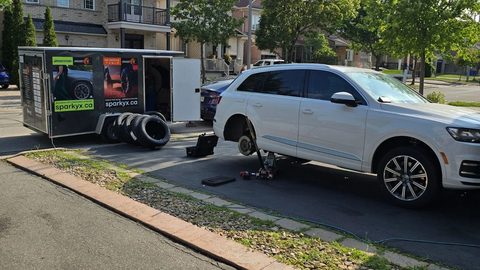

There was a frost advisory over Toronto and parts of the GTA this morning. It is 5°C out, it feels colder, and today's high is only about 9°C. By Thursday the forecast swings mild again.
That swing is exactly when this myth does its damage: "My SUV has all-wheel drive. I do not need winter tires."
We hear it on driveways every fall, from owners of AWD crossovers, 4x4 trucks, and dual-motor Teslas. It sounds logical. It is also wrong in the one way that matters — because all-wheel drive was never the part of your vehicle that stops you or steers you.
Here is the honest breakdown, the way we explain it to our own customers before they spend a dollar.
What all-wheel drive actually does
All-wheel drive sends engine or motor power to all four wheels instead of two. That helps you do exactly one thing better: get moving.
Pulling away from a snowy side-street stop sign, climbing an icy driveway in Richmond Hill, merging from a slushy on-ramp — AWD earns its money there. Two extra driven wheels means more chances for one of them to find grip and push you forward.
That is the whole job. AWD is an acceleration system. The badge on your tailgate says nothing about braking, and nothing about cornering.
Stopping and steering do not care about your drivetrain
Every vehicle on the road — front-wheel drive, rear-wheel drive, all-wheel drive, 4x4 — brakes with all four wheels and steers with the front two. There is no drivetrain setting that adds a fifth contact patch.
Your only contact with the road is four patches of rubber, each roughly the size of your hand. When you brake hard on a cold Gardiner Expressway ramp or turn onto an unplowed street in Scarborough, the grip available in those four patches is decided by one thing: the tire.
An AWD vehicle on all-season tires and a front-wheel-drive car on winter tires are not in the same league in a stop or a turn. The AWD vehicle will get off the line quicker — and then arrive at the intersection with the same problem as everyone else on the wrong rubber, only carrying more speed and more confidence.
That last part is why this myth is dangerous. AWD feels planted when you accelerate, so drivers trust it at speed. The first emergency stop on ice corrects that impression, at the worst possible moment.
Cold is the problem, not just snow
Most GTA winter driving is not through deep snow. It is on cleared, cold pavement — the 401, the DVP, Highway 404 — plus frost, black ice on bridges and ramps, and slush at intersections.
A winter tire is built for that. Its softer compound stays flexible in the cold, so the tread can conform to the road and grip. An all-season compound hardens as the temperature falls, and a harder tire grips less on cold dry pavement, cold wet pavement, and ice. That change is already underway at the temperatures on this morning's forecast.
The working rule in Ontario is the 7°C rule: when sustained temperatures sit at or below about 7°C, winter tires are the right tire on the car. We laid it out in full in when to switch to winter tires in Ontario. A frost advisory in late October is the season telling you the window is open — whatever Thursday's mild spell does.
And check the sidewall, not the brochure. A true winter tire carries the three-peak mountain snowflake symbol, which means it met a snow traction standard. An M+S marking alone on an all-season tire is not the same thing. Our winter tire buying guide for Toronto drivers walks through the symbol, the size, and the load index before you pay.
Four winter tires, never two
The cousin of the AWD myth is the two-tire shortcut: winters on the drive wheels only, all-seasons on the other axle to save money.
Do not do it. Winter tires should always be installed as a matching set of four. Mixing tire types creates a grip mismatch between the front and rear of the vehicle — one end holds, the other end lets go — and that is how a routine turn or a firm brake turns into a spin. Transport Canada advises against mixing brands, tread patterns, and sizes for the same reason.
If budget is the issue, say so when you call. A correctly sized, properly rated winter set in your price range beats a half-set of premium tires every time, and fall tire rebates plus the offers on our promos page can close a real part of the gap on a set of four.
AWD EVs and Teslas: more weight, same physics
Dual-motor Teslas and other AWD EVs make this myth feel even more true. Instant torque at all four wheels launches the car cleanly on a slippery street, and the traction control is fast and smart.
None of that shortens a stop. An EV is a heavy vehicle, and all of that weight has to be slowed down and turned by the tires. Regenerative braking and traction control manage the power the motors deliver; they cannot create grip the rubber does not have.
What an AWD EV actually needs is a winter package spec'd for the car: the correct size, a load rating that meets or exceeds specification — EV sizes are often XL, extra load — a true winter compound, and a TPMS plan sorted before install day. Tesla packages from Sparky X include pre-programmed Bluetooth TPMS sensors, and every tire and wheel package includes free mobile installation at your home or workplace. The details are on our Tesla and EV tire service page and the winter tire packages page.
What about all-weather tires?
Fair question. All-weather tires also carry the three-peak mountain snowflake symbol and can stay on the car all year, which makes them a reasonable compromise for some lower-mileage drivers. We compared them honestly in all-weather vs winter tires.
But note what an all-weather tire is: a tire. The compromise works because of the rubber, not because of the drivetrain. "AWD plus all-seasons" is the combination with no winter grip story at all.
The insurance angle nobody mentions
Ontario insurers offer a winter tire discount, and every insurer sets its own amount and its own proof requirements — typically the install invoice and the dates the winter tires are on the car. AWD does not earn that discount. Winter tires do. One quick call to your insurer tells you what yours needs, and it is one more reason the tires, not the badge, are the purchase that pays you back.
Frequently Asked Questions
Do I need winter tires if I have all-wheel drive?
Yes. All-wheel drive helps your vehicle get moving by sending power to all four wheels, but it does not help you stop or steer — every vehicle brakes and corners on all four tires. On cold, icy or snowy roads, grip comes from the tire compound and tread, so an AWD vehicle on all-season tires still needs a proper set of four winter tires in Ontario.
Does AWD help you stop faster in winter?
No. Braking uses all four wheels on every vehicle, whether it is front-wheel drive, rear-wheel drive or all-wheel drive. Your stopping grip comes from your tires. A winter compound that stays flexible below 7°C grips cold pavement, ice and packed snow in a way a hardened all-season compound cannot.
Can I put winter tires only on the drive wheels?
No. Winter tires should always be installed as a matching set of four. Mixing winter tires with all-season tires creates a grip mismatch between axles that can make the vehicle unstable in a turn or under braking — Transport Canada advises against mixing tire types, tread patterns and sizes.
Do dual-motor Teslas and other AWD EVs need winter tires?
Yes. Electric all-wheel drive delivers strong traction off the line, but an EV is heavy, and that weight has to be stopped and steered by the tires. A proper winter package — correct load rating, winter compound, and pre-programmed Bluetooth TPMS sensors on Tesla packages from Sparky X — is what gives an EV its winter grip.
Keep the AWD. Add the tires.
All-wheel drive is worth having in a GTA winter. It is just not a substitute for the only four things touching the road. Keep the drivetrain, fix the rubber, and your vehicle can actually do in a stop and a turn what it already does off the line.
You can search live pricing by size or vehicle in our shop, compare complete packages, and check the full list on our services page. Common questions are collected on the FAQs page.
Book online: sparkyx.ca/book
Call or text: (647) 819-0490
Sparky X Mobile Tire Shop — fully mobile across Toronto, the GTA, Durham and York. Our office is at 60 Hoile Drive in Ajax; all service happens at your home or workplace. We come to you.