
Every winter we get the same calls. Someone ordered tires or rims online because the website said “fits your vehicle,” the boxes showed up, and now nothing bolts on, nothing matches, or half the order has to go back. The website checked one spec — usually just the bolt pattern — and called it a fit. A real fitment is at least nine specs deep, and getting any one of them wrong costs you time, return freight, and sometimes the whole set.
Two of these happened on our own jobs in a single day this fall: a staggered electric SUV whose owner had been sold four identical tires, and a set of steel rims from a big online retailer that arrived with no thought given to the lug nuts the car actually needed. Here is the full checklist the online stores skip — the same one we run before a single dollar changes hands.
1. Staggered fitments: your car may not take four of the same
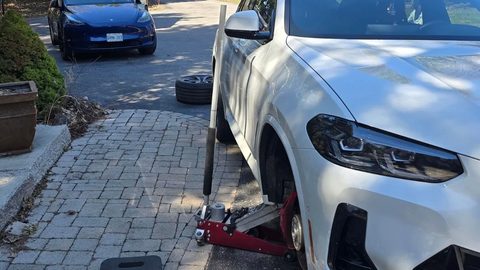
Many performance cars and EVs run a staggered setup: wider tires — sometimes even a larger rim diameter — on the rear axle. One BMW electric SUV we serviced runs 255/45R20 on the front and 275/40R21 on the rear. Order four identical tires for a car like that and two of them are useless. Your door-jamb placard lists the front and rear sizes separately for a reason. Read it before you read the product page.
2. Bolt pattern: necessary, nowhere near sufficient
The bolt pattern — say 5x114.3, five lugs on a 114.3 mm circle — is the one spec every online store checks, because it is the one spec that decides whether the wheel physically goes over the studs. But two cars can share a bolt pattern and share nothing else: different centre bores, different offsets, different brake sizes, different load ratings, different hardware. A wheel that “fits” a Mazda and a Tesla and a Toyota on pattern alone can be wrong for all three in four other ways. Bolt pattern is where fitment starts. Online stores treat it as where fitment ends.
3. Centre bore and hub rings: 1 mm is the difference between fit and doesn’t
Your wheel’s centre bore has to match your hub. 66.1 mm is not 67.1 mm: one millimetre too small and the wheel does not go on at all; too big and the wheel is centred by the lug nuts alone instead of the hub, which invites vibration and uneven clamping. That is what hub rings are for — a correctly sized ring fills the gap between an oversized aftermarket bore and your hub so the wheel sits hubcentric, exactly centred. Rings centre the wheel; they are a fitment part, not an accessory. If a listing never states the bore, it is not a fitment — it is a guess.
4. Offset and stance: where the wheel sits is a safety spec
Offset is the distance between the wheel’s mounting face and its centreline, in millimetres. It decides where the wheel sits in the arch — what people call stance. Push the offset too low and the wheel pokes out: tires rub fenders, road spray sandblasts your paint, and wheel bearings take loads they were not designed for. Too high and the wheel tucks in until the tire or rim meets a caliper or suspension arm. A few millimetres either way of the factory offset is normal on winter packages; a random “close enough” number off a universal listing is how you end up with a car that rubs on every full-lock turn.
5. Hardware: the lug nuts are part of the fitment
This is the one that bites hardest. Every wheel has a fastener seat type — 60° conical (cone), ball seat (in a few radius sizes), or flat mag/flange seat — and the nut or bolt has to match it exactly. Factory alloy wheels on many Toyotas and Mitsubishis use flat-seat flange nuts; most steel winter rims need conical nuts. A flange nut in a conical seat threads on and feels tight while clamping on a fraction of the intended contact area. Then there is thread pitch (M12x1.25 is not M12x1.5, and forcing it destroys studs), nuts versus lug bolts (many European cars use bolts, where shank length becomes a spec too), and ball-seat radii on German cars. We watched a customer get sent to a parts store mid-install this fall because the retailer that sold him his steel rims never mentioned fasteners once. Hardware is not a detail. It is the thing holding the wheel on.
6. Load rating: especially on EVs
Every wheel and tire carries a maximum load rating, and it has to clear half of your vehicle’s axle rating — the GAWR printed on your door sticker. EVs are heavy: some electric SUVs need more than 950 kg of capacity per rear wheel, and plenty of handsome wheels top out at 900 kg. They bolt on beautifully and are still the wrong wheel. No online checkout asks about your axle weights. We check them on every package.
7. Overall diameter: stay within 3%, and match all four
A replacement tire’s overall diameter should stay within about ±3% of the factory size. Outside that band, your speedometer, gearing, driver-assist calibration and — on all-wheel-drive vehicles — the drivetrain itself all pay for it. On AWD, the four tires also have to match each other closely in diameter, or the system spends its life fighting a difference that is not there. A “close enough” size that saves forty dollars can be the most expensive tire you ever buy.
8. TPMS: three different systems, one dashboard light
Some cars read sensors inside each wheel — and the type matters. Teslas use Bluetooth sensors; most other brands use 433 MHz radio sensors, often programmed or cloned to the car; some vehicles, like the VW ID. Buzz, use an indirect ABS-based system and need no in-wheel sensors at all. Order the wrong type and the warning light stays on no matter how perfect the balance is. Two more truths nobody prints on the box: a sensor cannot be fully tested before it is installed, and some sensors need real driving time to wake up and register — stubborn ones can take a day or two of trips before the car believes them.
9. Brake clearance: your trim sets the smallest rim
Big brake packages — standard fare on performance trims and EVs — set a hard floor on rim diameter and spoke shape. A 17-inch rim that fits the base model may not clear the calipers on the performance version of the same car, and some models use a stepped hub that needs a specially machined wheel. Fitment charts keyed to the model name alone do not know your trim. The placard, the axle sticker and the brake hardware do.
The real price of “cheaper online”
Add it up when an order goes wrong: return freight on four tires (they ship as freight, not envelopes), restocking fees, a second delivery wait in the middle of peak season, an install visit that cannot be completed, and a car sitting on the wrong rubber while the snow arrives. The money saved at checkout evaporates the first time anything has to go back — and that is before the safety items on this list, which do not come with a price tag at all.
How we do it at Sparky X
Every package we sell is verified against the actual car before payment: front and rear sizes off the placard, bolt pattern, centre bore measured against the hub, load rating against the axle weights, fastener seat and thread, TPMS type, offset, and brake clearance. If a spec cannot be verified, we say so before you pay — not after the boxes land. The set then arrives mounted and balanced with precision computer balancing, and gets installed in your driveway.
Ordering online is not the problem. Ordering blind is. Run all nine checks — or have someone run them for you before you click buy.
— Danny Popent, TIA Certified Tire Technician
Sparky X Mobile Tire Shop — (647) 819-0490 — sparkyx.ca