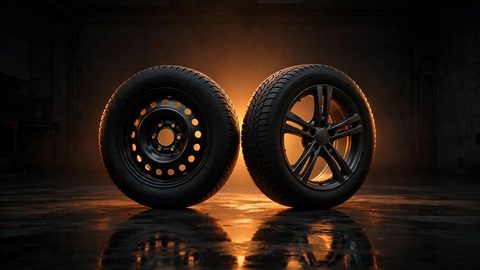

Every fall, drivers walk in — well, call in — holding the same question. Their car came on big wheels: 19s, 20s, wide low-profile tires that look great in July. Now they are pricing winter tires in that same size, the numbers are ugly, and someone has told them to “just go smaller for winter.” Is that real advice, or a sales trick? It is real — when it is done by the numbers. Downsizing, done right, is one of the oldest and best winter moves in Canada. Done wrong, it is a set of wheels that does not clear your brakes.
This is also the week to decide it. Toronto runs warm through Wednesday — highs in the high teens, even touching 20°C, with rain moving in Wednesday night. Then the pattern turns: Friday tops out around 13°C, Saturday drops to about 9°C with an overnight low near 4°C, and the start of next week sits at lows of 3 to 4°C with the first wintry-mix chances showing up in the outlook. A downsized winter package is not a grab-it-off-the-shelf purchase; the size has to be verified for your exact car. Verifying it takes days, not hours, and the calm warm days are the days to spend.
What downsizing actually means
Downsizing — fitters call it minus sizing — means fitting your winter tires on a smaller-diameter rim than the car came with, and making up the difference with a taller tire sidewall. One inch down is the standard move. The wheel gets smaller, the rubber gets taller and usually a little narrower, and the overall diameter of the tire stays almost exactly the same. That last part is the whole point: from the car’s point of view, nothing has changed. The speedometer still reads true, the gearing is untouched, and all-wheel-drive systems see four identical rolling diameters.
Two examples we build all the time. A sedan on 235/45R18 summers can run a 215/55R17 winter — the overall diameter works out within a millimetre. A crossover on a wide 255/50R20 can run a 235/65R18 winter at effectively the same diameter. And the most common downsized package in the GTA right now: a Tesla Model Y on 255/45R19 dropping to a 235/55R18 winter. That one carries a hard condition we will get to below — on the Model Y, 18-inch wheels fit the Base Rear-Wheel Drive only. Long Range and Performance cars need 19 inches minimum for brake clearance, full stop. We laid that out in detail in which Model Y trims 18-inch wheels actually fit.
Why a narrower tire works better in snow
It feels backwards. Surely the wide tire grips more? On dry pavement, yes — a wide tire puts a big, stable patch down. In snow and slush, the problem is different. A wide tire spreads the car’s weight over a large area, so it tends to ride up and float on top of loose snow and slush instead of cutting through it to the firmer surface underneath. A narrower tire concentrates the same weight on a smaller patch. It cuts through the slush layer on the 401 and the QEW, bites down, and tracks straighter through the ridges between lanes that try to push a wide tire around.
Anyone who has changed lanes through GTA slush at highway speed knows that floating, swimming feeling. That is the wide tire hydroplaning on slush. Narrower winters reduce it — not because they grip harder in some magical way, but because they reach the road instead of surfing what is on top of it. It is the same reason a pizza cutter beats a rolling pin. For a deeper walk through the numbers on a sidewall, see how to read your tire size and load index.
The taller sidewall is pothole insurance
The second benefit is pure GTA. Winter here is pothole season: freeze-thaw cycles tear up the pavement, and the holes hide under snow and slush water exactly when you cannot see them. On a low-profile tire, there might be only a few centimetres of rubber and air between the road and an expensive alloy rim. Every pothole is a rim-bending, tire-pinching coin toss.
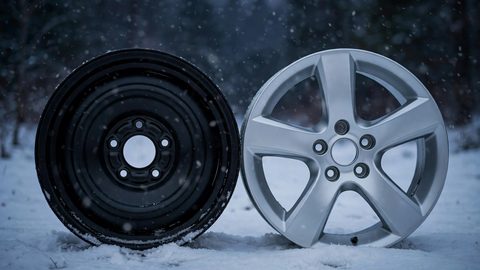
Drop an inch of rim and you gain that inch back as sidewall — more rubber, more air, more cushion between the pothole and the wheel. The taller sidewall flexes over sharp edges that would pinch a low-profile tire flat against its rim. It also rides better over the frozen ruts and broken pavement that pass for normal roads here from December to March. If you are choosing the wheels themselves, our breakdown of steel vs alloy winter rims in Toronto covers which survives this treatment best.
It usually costs less, too
The honest financial version: in the same tire model, a smaller size typically costs less than the big-diameter size, and smaller winter rims cost less than large ones. There is no exotic reason — less material, and the popular downsized sizes are made in far greater numbers than a wide 20-inch winter fitment, which is often a low-volume size that has to be ordered in. Downsized sizes also tend to stay available deeper into the season, when the fashionable sizes sell out. We will not put invented numbers on that; check your own car both ways in our tire and wheel shop and compare the verified sizes side by side. Complete tire and wheel packages include free mobile installation at your home or workplace either way, and seasonal manufacturer rebates may apply on a set of four — see tire rebates for the current programs.
The four checks that decide whether you can downsize
Here is where downsizing stops being a preference and becomes engineering. Four checks, and a downsized package has to pass all of them.
Brake clearance is the hard gate. The smaller rim has to fit over your brake calipers with room to spare, and on many modern cars — performance trims, big-brake packages, most EVs — it simply does not. This is not a maybe. If the wheel does not clear, the conversation is over, and no honest shop will sell you spacers and optimism instead. The Model Y rule above — 18s on Base Rear-Wheel Drive only — is exactly this check doing its job.
Overall diameter stays matched. The replacement size must keep the tire’s total diameter very close to the original. That keeps the speedometer and odometer honest, keeps driver-assistance and all-wheel-drive systems happy, and guarantees the tire still fits the wheel well at full lock and full suspension travel.
Load index never goes down. The downsized tire must carry at least the load rating the car came with. If the factory tire is XL — extra load, as most EV and crossover fitments are — the winter tire is XL too, at the same load index or higher. A cheaper standard-load tire in the right dimensions is still the wrong tire. This check fails closed: if we cannot verify the rating, the size does not get offered.
The wheel itself has to be the right wheel. Correct bolt pattern, a hub bore that sits hubcentric on your car or uses the proper rings, the right offset, and lug hardware that matches the wheel’s seat. Add TPMS: the sensors have to suit the car — Tesla packages include pre-programmed Bluetooth TPMS sensors — and a second set of wheels means the sensors live in the winter set permanently, which is half the convenience of a package in the first place.
When not to downsize
Plenty of cars should simply run winter tires in their factory size. If your brakes rule out a smaller rim, that is the end of it. If no verified downsized size exists for your trim, that is the end of it too — a size that fits a different trim of the same model is not a fitment, it is a guess. Staggered performance cars, where the rear tires are wider than the fronts from the factory, need a package engineered for that stagger, not a generic minus size. And if your car already sits on sensible 17s with a decent sidewall, there is little left to gain by going smaller; buy the winter tire, not the project.
Keep perspective, too. The biggest winter upgrade is the winter tire itself: a proper winter set in your factory size will out-stop, out-turn and out-climb an all-season by a margin that dwarfs the difference between factory size and downsized. Downsizing is an optimization — better in deep snow and slush, kinder over potholes, usually easier on the wallet. It is never a substitute for having winters on in the first place, which is the point of our winter tire buying guide for Toronto drivers.
Frequently Asked Questions
Can I put smaller rims on my car for winter tires?
Usually, yes — one inch down is a standard, well-proven conversion, as long as four checks pass: the smaller rim clears your brakes, the overall tire diameter stays matched to the original, the load index meets or exceeds the factory tire (XL stays XL), and the wheel specs — bolt pattern, hub bore, offset and lug seat — are correct for your car. If any check fails, run the factory size instead.
Will downsizing affect my speedometer?
Not when it is done properly. A correct minus-size conversion keeps the tire’s overall diameter almost identical to the original — the taller sidewall replaces the inch of rim you removed. That is what keeps the speedometer, odometer and all-wheel-drive system reading and behaving exactly as they did on the factory setup.
Are narrower winter tires really better in snow?
In loose snow and slush, yes. A narrower tire concentrates the car’s weight on a smaller contact patch, so it cuts through snow and slush to the firmer surface underneath instead of floating on top of it. On bare ice and dry roads the difference is small — downsizing is mainly a deep-snow, slush and pothole advantage, plus a cost one.
Can a Tesla Model Y run 18-inch winter wheels?
Only the Base Rear-Wheel Drive. On the Model Y, 18-inch wheels clear the brakes on the Base RWD trim only; Long Range and Performance cars require 19-inch wheels minimum. Any Model Y winter package also needs the correct load index and pre-programmed Bluetooth TPMS sensors, which our Tesla packages include.
Decide it this week, while the weather is easy
Downsizing is not a trick and it is not mandatory. It is a verified-size decision: smaller rim, taller and narrower tire, same overall diameter, same load rating, brakes cleared. Get those numbers right and winter gets easier — the car cuts through slush instead of surfing it, potholes stop being a threat to your rims, and the package usually costs less than the big-wheel equivalent. Get them wrong and you own wheels that do not fit. The verification is the product.
Tell us the car and we will tell you honestly whether a downsized package works for it — and if it does not, we will fit the right winter tires in your factory size instead. Book a visit: book mobile tire service. Tesla owners can start on our Tesla tire service page, everything we do is listed under services, and common questions are collected on the FAQs page.
Book online: sparkyx.ca/book
Call or text: (647) 819-0490
Sparky X Mobile Tire Shop — fully mobile across Toronto, the GTA, Durham and York. Our office is at 60 Hoile Drive in Ajax; all service happens at your home or workplace. We come to you.