
Thursday is forecast to hit about 21°C in Toronto. Friday night drops to about 4°C. The frost advisory that covered parts of the GTA north of the 401 earlier this week is already forgotten.
That swing is exactly when EV owners start asking us the wrong question in the right week: "If I put winter tires on, how much more range am I going to lose?"
Fair question. Wrong order. Cold takes its cut of your range whether you change tires or not — the battery and the cabin heater see to that. Winter tires are a small, honest line item in a much bigger bill, and they are the only line item on the list that also keeps you out of the ditch. Here is the full breakdown, the way we explain it on driveways across the GTA.
Where winter range actually goes
An electric vehicle loses range in the cold for three main reasons, and tires are not the biggest of them.
First, the battery itself. A cold battery is a less efficient battery — the chemistry inside it works slower when it is cold, so less of its stored energy is available to move the car, and it cannot accept regenerative braking energy as readily until it warms up. You may notice reduced regen on a cold morning, and the car telling you so. That is the battery protecting itself, not a fault.
Second, cabin heat. A gasoline engine makes waste heat for free and uses it to warm the cabin. An EV has no waste heat to spare, so heating the cabin draws power straight from the pack — power that would otherwise move the car. Models with a heat pump do this job far more efficiently than models heating with a simple electric element, which is one reason two EVs of similar size can lose noticeably different amounts of range in the same cold snap.
Third, the road itself fights back: cold, dense air, slush and snow on the pavement, and tires running below their proper pressure all raise the effort it takes to roll down the 401.
Put together, Canadian real-world winter testing commonly lands in the range of about 20 to 35 percent less range in normal cold-weather use, and more in extreme cold. Your number will move with the temperature, your speed, your heating habits, and how many short trips you take — short trips are the worst pattern, because the car pays the warm-up cost over and over and never settles into its efficient zone. The important part: that loss is temporary. The capacity comes back when the weather warms up. Cold costs you range for the day; it does not take your battery.
What winter tires cost you — honestly
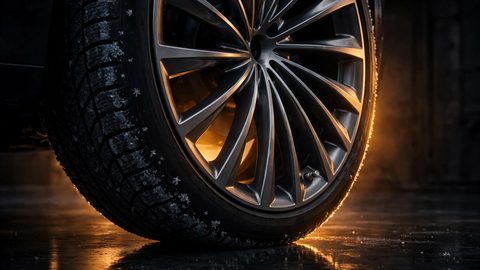
Yes, a winter tire can cost a little efficiency next to a low-rolling-resistance all-season. The softer compound and deeper, more open tread that grip ice and snow are not the lowest-drag design on the shelf. We will not pretend otherwise.
But keep the proportions straight. The battery and the heater are taking the large share of your winter range. The tire difference is the small share — and it shrinks further when the winter set is spec'd properly: the correct size for the car, a load rating that meets or exceeds specification (EV sizes are often XL, extra load), and pressures set to the door placard and kept there.
What actually wastes range on the tire side is sloppy spec and sloppy pressure, not the winter compound itself. An undersized or under-rated tire working too hard, a wheel-and-tire package heavier than it needs to be, and four tires running several psi low will cost you more than the tread pattern ever will. That is fixable with a correct package and a pressure gauge — which is the whole point of the next two sections.
And the trade runs one way only. Keeping all-seasons on to protect your range protects a number on the screen while giving up the thing range cannot buy back: grip. As we laid out in why AWD does not replace winter tires in Ontario, stopping and steering happen on the rubber, whatever the drivetrain — and that goes double for a heavy EV carrying battery weight into every stop.
Pressure: the range leak you can fix in five minutes
Tire pressure falls as the temperature falls — roughly 1 psi for every 6°C drop in outside temperature. A set of tires filled correctly on a mild October afternoon like this Thursday's can be measurably low by the first properly cold morning, with no puncture and no leak anywhere.
Low pressure costs an EV twice. It raises rolling resistance, which quietly eats range on every drive. And it dulls the tire's grip and wears its shoulders — the opposite of what you fitted winter tires for.
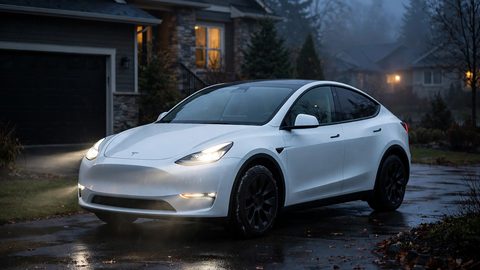
The fix is boring and free: check pressures cold, with a real gauge, against the specification on the driver's door placard — never the maximum molded into the tire sidewall. Check them monthly through the season and again after a sharp cold snap. If your tire pressure warning shows up on the first cold morning, start with pressure before you assume a sensor or a puncture — we covered how to tell the difference in why your TPMS light comes on in cold GTA weather. Tesla owners fitting a winter package also get pre-programmed Bluetooth TPMS sensors in every Sparky X package, and should know why a new sensor can take up to 48 hours to wake up before worrying about a blank reading.
Five habits that buy range back
You cannot repeal the physics, but you can stop paying more than you have to.
Precondition while plugged in. Warm the battery and the cabin on wall power before you leave, using your car's scheduled departure or app preconditioning. Energy spent warming up from the grid is energy the pack does not spend on the road — this is the single most effective winter range habit there is.
Heat yourself, not the whole cabin. Seat heaters and a heated steering wheel warm you directly and draw far less than blasting hot air through the entire cabin. Turn the cabin temperature down a few degrees and let the seats do the work.
Slow down a little on the highway. Aerodynamic drag climbs fast with speed, and cold air is denser air. A modest trim to your cruising speed on a long 401 run returns more range in winter than it does in July.
Keep the pressures right. See above. It is listed twice because it is the one most owners skip.
Tell the car what you fitted. After a winter changeover, update the wheel and tire setting in the car where it offers one — on a Tesla, that is under Controls, then Service, then Wheel and Tire. The car recalibrates its expectations for the new tires, and its range estimates get more honest.
The set-up we fit for EV winter driving
A proper EV winter package is not just four winter tires. It is a matching set of four — always four, never a pair — carrying the three-peak mountain snowflake symbol, in the car's correct size, with a load rating that meets or exceeds the placard specification. Tesla also recommends a full matching set of four winter tires, and warns against running winter tires with less than 4 mm of tread.
Every tire and wheel package from Sparky X includes free mobile installation at your home or workplace, and Tesla packages include pre-programmed Bluetooth TPMS sensors. Fall tire rebates and our promos can help with the cost of the set — check what is current before you order. The full package details are on our winter tire packages page, and everything we do for electric vehicles is on our Tesla and EV tire service page.
One timing note, because this week's forecast is the trap in person: a 21°C Thursday in late October is not a reason to wait. Sustained temperatures at or below about 7°C are when winter tires belong on the car — the 7°C rule we use every fall. By the time the first snow makes the decision obvious, it has made it for everyone at once.
Frequently Asked Questions
How much range does an EV lose in winter in Ontario?
Plan on roughly 20 to 35 percent less range in normal cold-weather use, and more in extreme cold. The loss comes mainly from the cold battery itself and from cabin heating, with slush, dense cold air and low tire pressure adding to it. The exact figure varies by model, temperature, speed and trip length — and it is temporary: the capacity returns when the weather warms up.
Do winter tires reduce EV range?
A winter tire can cost a little efficiency next to a low-rolling-resistance all-season, because its softer compound and deeper tread are built for grip, not minimum drag. But that difference is small next to what cold and cabin heating take, and it shrinks when the set is correctly sized, correctly load-rated and kept at placard pressure. Keeping all-seasons on to protect range gives up winter stopping and steering grip — a bad trade.
Does preconditioning really help winter range?
Yes. Preconditioning warms the battery and the cabin while the car is still plugged in, so that warm-up energy comes from the wall instead of the pack. Using scheduled departure or app preconditioning before you leave is the most effective single habit for protecting winter range, and it also means the car can accept regenerative braking properly sooner.
What tire pressure should my EV run in winter?
The pressure on the driver's door placard, checked cold with a gauge — never the maximum pressure molded on the tire sidewall. Pressure falls by roughly 1 psi for every 6°C drop in temperature, so a set filled on a mild day can be low on the first cold morning. Check pressures monthly and after sharp cold snaps.
Protect the grip first, then claw the range back
Winter will take some of your range. That part is physics, and no tire choice changes it. What you control is the rest: a correctly spec'd set of four winter tires at the right pressure, a preconditioned battery, and habits that do not waste the charge you have. That combination gets a GTA EV through winter with its grip intact and its range loss kept to the honest minimum.
You can search live pricing by size or vehicle in our shop, compare complete packages, and check the full list on our services page. Common questions are collected on the FAQs page.
Book online: sparkyx.ca/book
Call or text: (647) 819-0490
Sparky X Mobile Tire Shop — fully mobile across Toronto, the GTA, Durham and York. Our office is at 60 Hoile Drive in Ajax; all service happens at your home or workplace. We come to you.