
Toronto is still flirting with record warmth today — around 19°C with rain moving in this evening. By Saturday the forecast high is about 9°C, with the overnight low down near 5. That swing is exactly when electric vehicle drivers get caught out by something a gas car never does: the way their car slows down changes with the weather.
In an EV, lifting off the accelerator is not coasting. It is braking. Regenerative braking turns the motor into a generator, slows the car and sends energy back into the battery. In summer, on dry pavement, that one-pedal feel is smooth, predictable and easy to love. On a cold, wet or icy GTA road it needs more respect — and Tesla says so in its own owner’s manuals, in plain language most owners never read.
What regenerative braking actually does to your tires
Every slowing force in your car, however it is produced, ends at the same place: four contact patches, each about the size of a hand. The friction brakes squeeze discs. Regenerative braking drags on the driven wheels through the motor. The road does not care which system asked. It only has so much grip to give, and on ice it has very little.
That is the mechanical fact behind the manual warning. Tesla’s Model Y manual states that in snowy or icy conditions the car may experience loss of traction during regenerative braking — particularly in the Standard setting, and particularly when it is not on winter tires. Read that second condition again. The manufacturer is not just warning about a setting. It is warning about the combination of strong regen and the wrong rubber. A tire that cannot grip cannot be braked through, by any system, without sliding.
There is also a timing problem. Regen arrives the instant you lift. There is no pedal travel, no gradual squeeze, no moment where you feel the surface out first. On a dry road that instant response is a feature. On a patch of black ice on a bridge deck, mid-corner or on the polished ice at a stop sign, an abrupt lift can ask for a hard deceleration at exactly the moment the surface has the least to offer.
Cold weather changes regen a second way: there is less of it
Then winter does the opposite trick. Tesla’s manuals also state that regenerative braking may be limited if the battery is cold or already fully charged. A cold battery cannot accept energy back as readily, so the car protects it by reducing how much regen it allows. The car shows it on the power meter, and preconditioning before departure — warming the car and battery ahead of the drive — is the manual’s own way of reducing the limitation.
So a winter EV can give you too much regen on an icy lift-off in one moment, and noticeably less regen than you expected on a cold morning in the next. Both surprises have the same fix, and Tesla prints it too: use the brake pedal. Newer manuals describe an option, where fitted, to have the regular brakes automatically apply when regen is limited, so the deceleration feel stays consistent. The setting is not available on every vehicle, menus differ by model and software, and your own manual and touchscreen are the authority for your car — check them before the cold mornings arrive, not during one.
One more manual note that surprises people: installing winter tires with an aggressive compound and tread design may result in temporarily reduced regenerative braking power, and the car has a tire setting to tell it winters are fitted where that option exists. That is not a fault and not a reason to skip winters. It is the car relearning a tire with a different grip character. Set it, drive gently, and let it settle.
How to drive regen through a GTA winter
Lift early, lift gently. One-pedal driving in winter is a feathering skill, not an on-off switch. Ease out of the accelerator early and gradually, so deceleration builds instead of snapping on. If your EV lets you select a lower regen level — Tesla has recommended the Low setting, where fitted, in snow and ice to help maintain stability — use it on slippery days. Many other EVs offer paddle or menu control, or a snow or slippery drive mode that softens regen for you. The names differ; the principle does not.
Treat the brake pedal as the main tool again. The friction brakes are progressive, they work on all four wheels, and the anti-lock system is built to manage them at the edge of grip. In summer many EV drivers barely touch that pedal. In winter, plan to use it: brake earlier, brake gently, and leave a bigger following gap so no single stop has to be a hard one. Regen is assistance, not a stopping guarantee.
Precondition, and expect the first kilometres to feel different. A scheduled departure or a manual precondition warms the battery, restores more normal regen and clears the glass while the car is still plugged in. Then drive the first few minutes knowing the car may still be warming: less regen than usual at first, more as it warms. Consistency is something you manage in winter, not something the car promises.
Slow down before the corner, not in it. Braking force — regen or friction — and steering force share the same grip budget. Spend that budget in a straight line, on the approach, and roll through the turn asking the tires only to steer. That rule matters double on the surfaces the GTA serves up in the same block: wet asphalt, slush, then a sheet of ice in the shade.
None of this works without actual winter grip
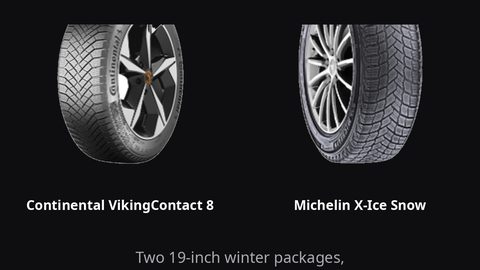
Here is the part settings cannot fix. Regen management decides how politely you ask for grip. The tire decides how much grip exists. An all-season tire in near-freezing rain is already spending a hardening compound’s limited budget, and instant EV torque makes the request bigger from a standstill. A proper winter tire — three-peak mountain snowflake rated, fitted as a matched set of four, at the load rating your EV’s door placard calls for — is what gives the braking systems, all of them, something to work with. We covered the range side of that equation in how winter tires affect EV range in Ontario, and the package side in the Tesla Model Y winter tire guide for the GTA.
This week is the practical moment to sort it. Today is warm and wet; the weekend is cold enough for frost on bridges and icy patches in the shade — the exact mixed surface regen handles worst, which we broke down in why GTA overpasses freeze first. Complete tire and wheel packages include free mobile installation, Tesla packages include pre-programmed Bluetooth TPMS sensors, sets of four can carry manufacturer rebates — see tire rebates — and you can shop what is actually available in the tire and wheel shop.
Frequently Asked Questions
Should I turn regenerative braking down in snow and ice?
If your EV lets you, yes on slippery days. Tesla’s manuals warn of traction loss during regenerative braking in snow and ice, particularly in the Standard setting, and recommend the Low setting where fitted. Where there is no level control, ease off the accelerator gradually instead of lifting abruptly, and use the brake pedal for planned stops.
Why is my regenerative braking weaker on cold mornings?
Because the battery is cold. Tesla’s manuals state that regen may be limited when the battery is cold or fully charged, and that it increases as the battery warms. Preconditioning before departure reduces the limitation. Until it warms, expect less one-pedal deceleration and use the brake pedal.
Does regenerative braking replace the brake pedal in winter?
No. Regen slows through the driven wheels only, and its strength varies with battery temperature and charge. The friction brakes work on all four wheels, are progressive, and are managed by the anti-lock system. Tesla’s own guidance is to use the brake pedal when regen is limited — in winter, plan stops on the pedal and let regen assist.
Do winter tires affect regenerative braking?
Yes, briefly. Tesla notes that fitting winter tires with an aggressive compound and tread may temporarily reduce regen power, and many EVs have a setting to tell the car winter tires are fitted. That settles as the car adapts. It is not a reason to stay on all-seasons: the manual links traction loss in regen specifically to not using winter tires.
The bottom line for EV drivers
Regenerative braking is a good system with a winter personality change. It can bite harder than the surface allows when you lift abruptly on ice, and it can go quiet on a cold battery when you were counting on it. Neither behaviour is a defect. Both are in the manual, both are predictable once you know them, and both are managed the same way: gentler inputs, the brake pedal back in charge, a warmed battery — and winter tires underneath it all, because no software setting manufactures grip.
Get the winter set on before the weekend cold does it for you. Book a visit: book mobile tire service. Tesla and EV owners can start on our Tesla tire service page, everything we do is listed under services, and common questions are collected on the FAQs page.
Book online: sparkyx.ca/book
Call or text: (647) 819-0490
Sparky X Mobile Tire Shop — fully mobile across Toronto, the GTA, Durham and York. Our office is at 60 Hoile Drive in Ajax; all service happens at your home or workplace. We come to you.