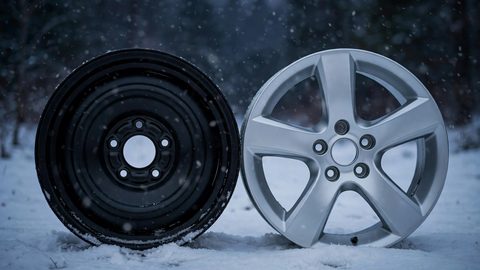

Every family has one. The main car gets the attention: new winter tires booked early, pressures checked, everything ready before the cold lands. The second car gets whatever is left. It is the partner's older sedan, the runabout a teenager takes to practice, the spare vehicle that mostly sits — until the one night it is suddenly the only car available, on the worst road of the week.
This Sunday is the day to close that gap. Toronto starts under a fog advisory this morning, reaches about 14 degrees this afternoon, then drops hard: about 8 degrees and windy on Monday with an overnight low near minus 2, and just 3 degrees on Tuesday. Sunset is now 4:45 p.m., so family driving — pickups, practices, the drive to grandparents — happens in the dark. Here is the second-car check, tires first, that takes one driveway visit and one honest look.
Why the second car is always the risky one
It is not neglect. It is arithmetic. The car that carries the family every day announces its problems: you feel the vibration, you see the pressure light, you notice the tread when you load the trunk. The second car can sit for days between short trips, and short trips hide everything. A slow leak never gets a long enough drive to trigger a warning you notice. Worn tread never gets a highway run in the rain. An old tire never gets looked at in daylight, because the car leaves before sunrise and comes home after dark.
Then comes the night the pattern breaks. The main car is in for service, or a parent is away with it, or a teenager borrows the second car for a longer drive than usual — in freezing rain, on unfamiliar roads, in the dark. That is the exact moment the second car's tires matter most, and it is the moment nobody planned for. Winter does not ask which car in your driveway is the important one. It tests whichever one is moving.
Check one: are winter tires actually on it?
Start with the simplest question, and do not answer it from memory. Walk out and look. Every fall we hear the same story in some form: a driver certain the winters went on, on a car still wearing all-seasons — because the swap happened on the other car, or it was planned and never booked, or last spring's changeover note was about a vehicle the family no longer owns.
Look for the three-peak mountain snowflake symbol on the sidewall. That marking is the severe-snow standard a true winter tire is tested against, and it is the same check we walk through in our winter tire buying guide for Toronto drivers. An M+S marking alone is not the same thing — it describes a tread pattern, not tested snow performance. If the second car is on all-weather tires with the snowflake symbol, that is a legitimate winter-rated choice for a lightly driven car. If it is on plain all-seasons in late November, with overnight lows about to go below zero, that car is not winter-ready no matter how new the tires look.
Check two: tread depth, not tread hope
A little-used car creates a specific trap: the tires look fresh because they have barely been driven, so nobody measures them. Measure anyway. Winter grip lives in tread depth — the grooves are what move slush and snow out from under the tire — and Transport Canada guidance treats about 4 mm as the working minimum for winter use. A tire can look fine from three steps away and be under that line in the centre grooves.
Check all four, and check across the tread, not just the easy outer edge. Uneven wear on a second car is common and easy to miss: it sits more than it drives, alignment drifts unnoticed, and one shoulder can be worn smooth while the rest of the tire looks healthy. If one tire is noticeably worse than the other three, that is not a quirk to live with — on a slippery road, the weakest tire sets the car's limit in a stop or a turn. Our guide to how long winter tires last in Ontario shows the wear patterns worth recognizing.
Check three: age beats mileage on a car that sits
Here is where the second car really differs. Tires age even when they are not being used. Rubber hardens and develops fine cracking over time from temperature swings, sunlight and simply sitting under the car's weight in one position for weeks. A low-mileage second car can easily be running the oldest tires in the household — bought years ago, barely worn, and quietly past their best as winter rubber.
Find the DOT code on the sidewall: the last four digits give the week and year the tire was made. Then look closely at the sidewalls and between the tread blocks for fine cracks. Hard, cracked rubber does not flex and bite the way a winter compound needs to below 7 degrees, whatever the tread depth says. We covered the full inspection in are your stored winter tires still safe to use — the same checks apply to a set that never left the car. If the second car's winters are old and cracking, replacing them is not upselling. It is the whole point of having a second car you can trust.
Check four: pressure, the spare, and the forgotten corners
A car that sits loses pressure unnoticed, and pressure falls further as temperatures drop — roughly 1 to 2 psi for every 10-degree Celsius drop, per tire-maker guidance. A set filled during a mild spell can be well low by Tuesday morning without any puncture. Check all four cold, set them to the figure on the driver-door placard, and do not skip the one everyone skips: the spare. A spare that has sat untouched in a trunk for years is often flat or nearly flat, which turns a simple puncture into a tow. Check it the same day, while you are already holding the gauge.
While you are there: confirm the jack and lug wrench are actually in the car, and if the wheels were recently swapped, remember the re-torque check after about 50 kilometres of driving from our re-torque guide. Second cars are where tools quietly migrate to the main car's trunk and never come back.
Who drives it matters as much as what it is
Be honest about the driver, too. Second cars are disproportionately driven by the least experienced person in the household — a newly licensed teenager, a young adult home from university — or handed to a visiting family member who does not know the car at all. An experienced driver can feel a car start to slide and correct early. A new driver needs the tires to do more of that work for them, and needs margin they do not yet know how to create with speed and following distance.
So hold the second car to the higher standard, not the lower one. Good winter tires, correct pressure, a working spare, and a quick conversation before the keys change hands: slow down earlier, leave more room, and remember that sunset is before 5 p.m. now, so the drive home from anywhere is a night drive. If a young driver will be on the 401 or the QEW this week, the route guidance in our first snow commute guide is worth the two minutes it takes to share.
How Sparky X can help
Sparky X is a fully mobile tire shop, which makes the second-car problem easy to solve: both cars can be handled in the same driveway visit, at home, while your family gets on with its Sunday. Verified sizes and load ratings are in the tire and wheel shop, complete setups are on the tire and wheel packages page — packages include free mobile installation, and Tesla packages include pre-programmed Bluetooth TPMS — and current offers sit on the tire rebates page. The full service list is on the services page, and common questions are answered in the FAQs. Sparky X serves Toronto, the GTA, Durham and York. Our office is at 60 Hoile Drive in Ajax; it is office only, and no vehicle service happens there.
Frequently Asked Questions
Our second car barely gets driven. Does it really need winter tires?
Yes, if it will be driven at all in winter. Winter tires are about the conditions on the trips it does take, not the total kilometres it covers. A rarely driven car is often needed suddenly — when the main car is unavailable — and those unplanned trips tend to happen in the worst weather, in the dark, with no chance to prepare the car first.
Can the second car share the main car's winter wheels?
Almost never. Wheels are vehicle-specific: bolt pattern, hub bore, offset, brake clearance and lug hardware all have to match, and the tire size and load index have to be right for that car. Swapping a set between two different vehicles because the tire size looks close is how fitment mistakes happen. Each car needs its own verified setup.
The tires look new but they are several years old. Are they still fine?
Look closer before deciding. Tires age even with little use: rubber hardens and fine cracking develops, especially on a car that sits outdoors. Check the DOT date code on the sidewall and inspect for cracking between the tread blocks and on the sidewalls. A hard, cracked winter tire can have full tread and still grip poorly in the cold.
What is the fastest second-car check I can do today?
Five minutes covers the essentials: confirm winter tires with the snowflake symbol are actually fitted, check all four pressures cold against the driver-door placard, look at tread depth and sidewalls for wear or cracking, and check the spare tire's pressure. Anything that fails one of those checks is worth fixing before the cold lands this week, not after.
The bottom line
The safest family fleet is only as strong as the car nobody checked. This week gives you a mild, foggy Sunday to do the check, before Monday night drops below zero and Tuesday sits at 3 degrees in the dark by 5 p.m. Look at the second car's tires today — symbol, tread, age, pressure, spare — and fix what you find while it is still a choice.
Want both cars handled in one visit? Book online and we will come to you.
Book online: sparkyx.ca/book
Call or text: (647) 819-0490
Sparky X Mobile Tire Shop — fully mobile across Toronto, the GTA, Durham and York. Our office is at 60 Hoile Drive in Ajax; all service happens at your home or workplace. We come to you.