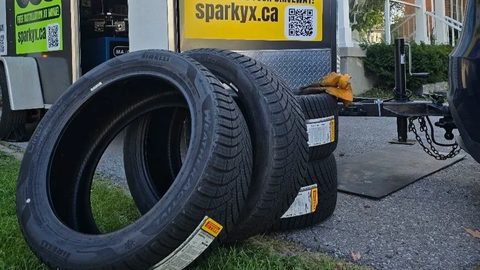

It is the first week of November in Toronto and it feels like September. Environment Canada has the city reaching about 20°C today and 21°C on Wednesday — more than double the normal daytime high for this time of year. So the calls we are getting this week are not panicked. They are hesitant. “I know I should book my winter tires,” people say, “but if I put them on in this weather, won’t the warm pavement just chew them up?”
It is a fair question, and it is built on a real fact: winter tires do wear faster in warm weather. Michelin says it plainly, and Tire Rack’s testing experts say running winter tires through the summer sends the wear rate up — in their words, you are throwing dollars away. But a myth has grown on top of that fact, and the myth is the leap from “winter tires wear faster in heat” to “a mild week in November will ruin a set installed a little early.” Those are not the same claim. One is about a season. The other is about a few days. Wear does not work in days. It works in heat, distance and time.
Why winter tires wear faster when it is warm
Start with why the tire exists. A winter tire is built from a softer rubber compound that stays flexible when temperatures fall, so the tread can conform to cold pavement, packed snow and ice instead of skating on top of them. That softness is the whole product. It is also the trade: a compound soft enough to grip at −20°C gives up some of itself more readily on warm, dry asphalt. The flexible tread blocks squirm more under braking and cornering loads, and squirm is wear.
Heat is the multiplier. A tire does not care what month the calendar says; it cares how hot the pavement is, how far and how fast it is driven on that pavement, and how hard it is worked. A winter tire run through a Toronto summer — months of hot asphalt, long highway runs, cottage-country mileage — will genuinely wear at a rate its owner will notice and regret. That is the scenario every manufacturer warning is actually about. Nobody serious disputes it, and it is why we tell every customer the same thing in April: when spring temperatures settle, the winters come off. We covered the other side of that timing question in when to switch to winter tires in Ontario and the 7°C rule.
What a mild November week actually does to a set
Now put the real numbers on this week. Today and Wednesday are the warm peak: around 20 to 21°C, in a month where the normal high is about 9 or 10. Then the pattern breaks — mid-teens Thursday and Friday, and by Saturday the high drops to about 8°C, with overnight lows falling toward 3. In other words, the “warm weather” anyone is protecting their winter tires from is roughly three to four mild days, most of them spent on ordinary commuting, before the GTA is back to exactly the temperatures winter tires are built for.
Wear accumulated over a few mild days of normal driving is real but small — a thin slice of a tread life measured in seasons. Compare what it buys. The driver who installs this week drives those same days on a tire that feels a little softer in the warmth, then wakes up Saturday already on winters as the temperature falls through the range where all-season rubber starts giving up grip. The driver who waits to protect the tread owns a perfect, unworn set — sitting in the garage, on the wrong car, while they drive through the first cold rain and frost of the season on tires that are hardening by the night. Unworn is not the same as useful.
The honest trade-offs of running winters in a warm spell
We are not going to pretend there is no downside beyond wear, because there is, and you will feel it. On warm, dry pavement a winter tire’s steering feels softer and less precise than a summer or all-season tire, and hard emergency braking in real heat is not what the compound is for. Tire Rack’s experts make the same point: the technology that makes a winter tire remarkable in the cold comes with compromises as temperatures climb. For a few mild November days at city and highway commuting speeds, that trade is mild and temporary. For a full summer, it is neither. Duration is the difference between a myth and a fact.
There is also a booking reality attached to the physics. The warm spell ends for everyone on the same Saturday. Every driver who spent this week waiting for “proper” winter weather will try to get installed in the same following days, on top of everyone who was already booked. Installing during the mild days is not just safe for the tires — it is how you avoid the rush entirely. And if you are buying rather than swapping, this is also the week sizes start to thin out; our tire and wheel shop shows what is actually in stock, and complete tire and wheel packages include free mobile installation, with seasonal manufacturer rebates on many sets of four — see tire rebates for the current programs.
How to keep wear low if your winters go on early
If your winters are going on during a mild spell, the wear you can actually control has very little to do with the date and a lot to do with four ordinary things.
Pressure first. An underinflated tire flexes more, builds more heat and wears faster in any weather — and pressure falls as temperatures drop, which is why the TPMS light loves the first cold mornings. We explained that pattern in why your TPMS light comes on in cold weather. Set pressures to the number on your driver-door placard, not the number on the tire sidewall.
Drive them like it is November, not July. Aggressive cornering, late braking and hard launches work any tire harder; on a soft winter compound in mild weather they cost more tread. A calm few days costs almost nothing. Save the enthusiasm for spring.
Do not stretch it into a season. The myth-bust has a boundary. Installing in early November ahead of a forecast plunge is smart. Leaving winters on through May, June and a summer road trip because the swap is inconvenient is exactly the use case the manufacturers warn about — that is where real tread life goes. The swap back matters as much as the swap on, and how long a set should last overall is its own question, covered in how long winter tires last in Ontario.
Store the summer set properly. The tires coming off deserve the same care as the ones going on: clean, dry, out of direct sunlight, and checked before they go back on in spring. Our checklist for that is in how to tell if stored tires are still safe to use.
Frequently Asked Questions
Will a few warm days ruin my winter tires?
No. Winter tires do wear faster in warm weather, and running them through a whole summer genuinely wastes tread — but wear builds with heat, distance and time. A few mild November days of normal commuting, right before temperatures plunge, costs a thin slice of a tread life measured in seasons. It does not ruin a set.
When does warm-weather wear actually become a problem?
When it stops being a few days and becomes a season. Months of hot pavement, long high-speed highway runs and summer mileage are what manufacturers and Tire Rack warn about. That is why winters come off in spring when temperatures settle — and why a mild week in November is a different situation entirely.
Should I wait until temperatures stay below 7°C before booking?
Book now, even if the install lands in the mild days. The 7°C rule describes when winter compounds start outperforming all-season rubber, not a booking deadline. This week Toronto falls from about 21°C on Wednesday to about 8°C by Saturday — waiting for the cold to arrive before booking just puts you in the rush it creates.
How do I limit wear if my winter tires go on during a mild spell?
Set tire pressures to the driver-door placard figure, drive gently for the first days — no hard cornering, late braking or launches on the soft compound — and keep the arrangement temporary. The real wear risk is leaving winters on into spring and summer, not installing them a few mild days early.
The myth, settled
Here is the whole thing in one line: winter tires wear faster in warm weather, and they wear out in summers, not in mild November weeks. The fact is real. The fear built on it — that installing ahead of a cold snap will chew up a set — has the scale wrong by a season. This week the GTA gets its last warm days and then an eight-degree weekend. The drivers who use the warm days to get installed will meet that weekend ready. The drivers protecting their tread from three mild days will meet it on all-seasons, in a booking queue.
Get the winters on while the weather is easy and the calendar is open. Book a visit: book mobile tire service. Tesla owners can start on our Tesla tire service page — Tesla packages include pre-programmed Bluetooth TPMS sensors — everything we do is listed under services, and common questions are collected on the FAQs page.
Book online: sparkyx.ca/book
Call or text: (647) 819-0490
Sparky X Mobile Tire Shop — fully mobile across Toronto, the GTA, Durham and York. Our office is at 60 Hoile Drive in Ajax; all service happens at your home or workplace. We come to you.