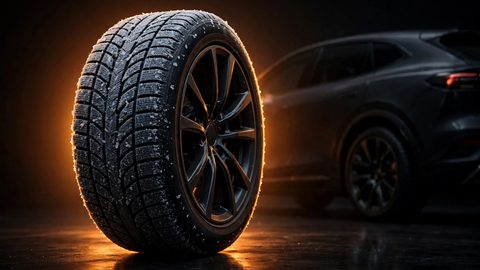

Every winter tire listing for a Tesla or another electric vehicle seems to shout the same two words now: EV rated. Some listings add a foam icon. Some add XL. Some add a string of letters that looks like a password. Drivers are left with a fair question: which of those labels actually change how the tire works in a GTA winter, and which ones are just decoration on the listing?
Here is the straight answer. EV rated is not one single feature, and it is not a government standard with a test your tire passes or fails. It is a bundle of separate things — load construction, quietness, rolling resistance, and sometimes a factory homologation mark — and they do not matter equally. One of them is non-negotiable. One of them is genuinely nice to have. One of them protects range at the margins. Sorting them out matters this week in particular: Toronto is running sunny and mild, with highs around 13 to 15 degrees through Friday, before the forecast drops hard early next week, toward a high near 3 degrees and an overnight low near minus 5 by Tuesday, November 24. This mild window is the time to choose a winter set on facts, not on badges.
First, the part that is not optional: load index and XL
An electric vehicle is heavy for its size. The battery sits low and helps handling, but it still has to be carried, cornered, and stopped by four contact patches. That is why the factory tires on common Tesla fitments carry high load indexes in XL — extra load — construction. A Model Y on 19-inch wheels, for example, runs 255/45R19 in a 104 XL rating from the factory, and Tesla's own guidance is that a replacement tire's load and speed ratings should equal or exceed the original equipment.
XL is not marketing. It describes a reinforced tire construction built to carry more load at higher inflation pressure than a standard-load tire of the same size. The number beside it — the load index — is the actual capacity figure. The rule we apply to every EV package is simple and it does not bend: the winter tire's load index must meet or exceed the figure on the driver's door placard, and where the factory tire is XL, the winter tire stays XL. A winter tire that is cheaper because it quietly drops the load rating is not a deal. It is the wrong tire, no matter what EV badge the listing carries. We explain how to read those numbers yourself in our guide to reading your tire size and load index.
Foam inside the tire: real, useful, and not a grip feature
The foam is real. Many EV-focused tires carry a layer of acoustic foam bonded inside the casing, under the tread. Manufacturers sell it under their own names — Michelin's Acoustic technology, Pirelli's Noise Cancelling System, and Continental's ContiSilent are the best-known versions — but the job is the same: the foam absorbs the cavity resonance that makes a tire hum on the highway.
It matters more in an EV than in a gas car for one obvious reason. There is no engine noise covering the tire noise. On a quiet electric drivetrain, road roar is the loudest thing in the cabin, so damping it is a genuine comfort gain on a 401 run. But be clear about what foam does not do. It does not add winter grip. It does not carry load. It does not extend range in any way you will measure. A foam-lined tire with the wrong load index is still the wrong tire, and a winter tire with no foam at all — plenty of excellent ones have none — can still be exactly the right tire. In our own SparkyXConnect listings we state foam plainly as a fact, yes or no, under the EV rated line, because that is what it is: a fact about the tire, not a promise.
Rolling resistance and range: the honest trade
EV-specific tires are usually tuned for low rolling resistance — compounds and constructions that waste less energy as the tire rolls. That tuning is part of how factory EVs post their range figures, and Tesla-specific factory tires are developed with it in mind. It is also where winter forces an honest trade.
A winter tire's first job is grip in the cold: a compound that stays flexible below 7 degrees, deep tread, and dense siping. Building all of that while keeping rolling resistance at summer all-season levels is not physically on offer. A good EV-focused winter tire keeps the range penalty small; it does not erase it. And the penalty from the tires is still the small part of winter range loss next to the cold battery and cabin heating, which we broke down in our article on EV winter range loss in Ontario. Keeping a stiffened all-season on your Tesla to protect a few kilometres of range, while giving up winter braking and steering grip, is the worst trade on the table. Choose the winter tire for grip and load first, then prefer the lower-resistance option among the tires that pass those gates.
T0, T1, T2 and other letters: homologation is a marker, not a verdict
Some factory Tesla tires carry a T0, T1, or T2 mark on the sidewall. That is a homologation mark: it says the tire maker built and validated that version to Tesla's own specification for noise, resistance, load, and behaviour on the car. It is useful information about the factory tire. It is not a requirement for a replacement winter tire.
Plenty of correct winter fitments carry no T mark at all, because they were built as replacement-market winter tires rather than as Tesla factory equipment. What makes them correct is the checklist, not the letter: right size, load index at or above the placard with XL where the factory tire is XL, the three-peak mountain snowflake symbol that identifies a true winter tire, and a tread with enough depth left to clear slush. Judge a winter tire by those four things and the homologation mark goes back to being what it should be — a marker that tells you something, never a gate that decides for you.
Torque and weight: why EV winters work harder
Electric motors deliver their torque immediately, and EV drivers feel that as effortless acceleration. The tires feel it as work. Instant torque plus battery weight is hard on tread, especially in the first metres from a stop on a cold, slippery surface, and it is a big part of why EV winter tires wear faster. Two habits protect a set. First, ease into the throttle in snow and ice — it is a grip habit and a wear habit at the same time, and it pairs with the regenerative braking adjustments we covered in our guide to regenerative braking on ice. Second, keep pressures at the door placard figure, checked cold. A heavy EV on underinflated winter tires wears the shoulders, wastes range, and gives up steering precision all at once.
So what should a GTA EV driver actually buy?
Run the checklist in order. One: a true winter tire with the three-peak mountain snowflake, in your factory size or a verified downsize — and remember that on a Model Y, 18-inch winter wheels fit the Base Rear-Wheel Drive only; Long Range and Performance cars need 19-inch minimum for brake clearance. Two: load index at or above the door placard, XL where the factory tire is XL. Three: a full set of four matching tires, because two winter tires are not enough on any drivetrain. Four: among the tires that pass, take the EV-focused options — foam if quiet matters to you, lower rolling resistance if range matters to you. Current winter lines we fit on EVs, such as Michelin's X-Ice Snow family and Continental's VikingContact 8, are built and rated with these EV requirements in mind; the specific model matters less than passing the gates above.
When you are comparing complete setups, start with verified sizes and fitment in the tire and wheel shop, compare built packages on the tire and wheel packages page, and check the current offers on the tire rebates page before you pay. Tire and wheel packages include free mobile installation, and Tesla packages include pre-programmed Bluetooth TPMS sensors, so the sensors are matched to the car before we arrive — with the standing note that Bluetooth sensors can take some driving to wake up, and if one still has not woken after 48 hours, we come back and replace it at no cost.
What Sparky X checks on every EV winter package
Every EV package we build gets the same verification before it is quoted: size against the vehicle, load index against the door placard, XL confirmed where the factory fitment is XL, wheel bolt pattern, hub bore, offset, and lug seat checked against the car, and TPMS type confirmed — Bluetooth sensors for the Teslas that use them, and no sensors at all quoted for trims that run indirect TPMS. At the install, wheels are fitted with precision computer balancing and torqued to the manufacturer's specification, in your driveway. Sparky X is fully mobile across Toronto, the GTA, Durham and York. Our office is at 60 Hoile Drive in Ajax; it is office only, and no vehicle service happens there. Read how it works on the services page or check the FAQs before you book.
Frequently Asked Questions
What does EV rated actually mean on a winter tire?
It is a bundle, not a single standard. It usually points to some combination of high load capacity for battery weight, low rolling resistance to protect range, reinforced construction, and sometimes an acoustic foam liner for quiet. There is no single pass-or-fail EV test. Judge each part separately: load index is a hard requirement, foam is comfort, and rolling resistance is a smaller range factor.
Does my Tesla winter tire have to have foam inside?
No. Acoustic foam bonded inside the casing reduces the cavity hum you hear on the highway, which is noticeable in a quiet EV cabin. It does not affect winter grip, load capacity, or safety. Many correct winter tires for Teslas have no foam. In our listings we state foam as a plain fact — yes or no — so you can weigh it as the comfort feature it is.
Can I use a winter tire without a T0, T1 or T2 mark on my Tesla?
Yes. Those marks identify tires built to Tesla's factory specification. A replacement winter tire without one is still correct if it matches your size, meets or exceeds the door placard load index — staying XL where the factory tire is XL — and carries the three-peak mountain snowflake symbol. Homologation is information, not a requirement.
Why does the load index matter so much on an EV?
Because the battery makes an EV heavy for its size, and the load index is the tire's certified carrying capacity. Tesla's factory fitments use high indexes in XL construction — 104 XL on a 19-inch Model Y, for example. Fitting a lower-rated tire than the placard calls for gives up the safety margin the car was designed around, whatever badge the listing carries.
The bottom line
EV rated is a starting point for questions, not an answer. The load index and XL construction are the gate — a winter tire that fails them is out, foam or no foam. The three-peak mountain snowflake says it is a real winter tire. After those gates, foam buys quiet and low rolling resistance buys back a little range, and both are worth having. Use this mild week to run the checklist while the choosing is calm, before next week's cold turn makes it urgent.
Need an EV winter package verified for your exact car and fitted in your driveway? Book the visit online and we will come to you.
Book online: sparkyx.ca/book
Call or text: (647) 819-0490
Sparky X Mobile Tire Shop — fully mobile across Toronto, the GTA, Durham and York. Our office is at 60 Hoile Drive in Ajax; all service happens at your home or workplace. We come to you.