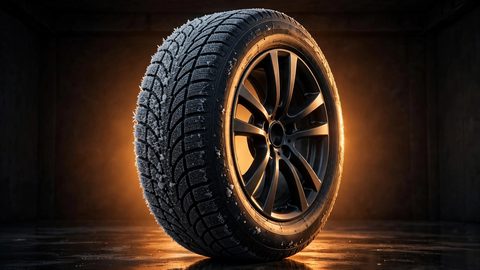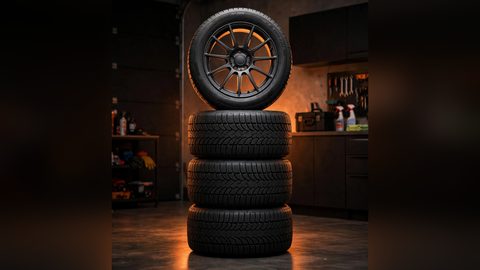

Every November, the same money-saving idea makes the rounds in GTA driveways: my car is front-wheel drive, the front tires do the steering and the pulling, so two winter tires on the front should be enough — right? This week makes the idea tempting. Toronto is mild today, with a high near 15°C, but Thursday night drops to 0°C with a chance of rain showers or flurries, and Friday stays cold. The season is about to start, budgets are tight, and two tires cost half as much as four.
Here is the straight answer, before the physics: two winter tires are not a half-price version of a winter setup. They are a different, unbalanced setup — and the imbalance shows up at the worst possible moment, mid-corner or mid-brake on a slippery road, when the end of the car with less grip lets go first. Transport Canada recommends installing winter tires in sets of four. The Tire and Rubber Association of Canada is blunter: anything less than four compromises safety. This guide explains why, what the official guidance actually says, and what to do instead if the budget is the real problem.
The short answer: four winter tires, always
A car does not use its four tires the way the two-tire idea assumes. Getting moving is only one job, and it is the easiest one. Braking uses all four contact patches. Cornering uses all four. Holding a straight line on a slushy highway, recovering from a gust or a rut, stopping for the light that turned yellow on a frosty morning — all four, every time. The driven axle decides whether you can pull away from a stop sign. The other three jobs decide whether you arrive.
That is why every serious source lands in the same place. Transport Canada recommends winter tires in sets of four, with the same type, size, speed rating and load index on all four wheels for predictable handling. Ontario’s official driver’s handbook recommends four winter or all-weather tires with the same tread pattern, and warns against mixing winter tires with all-season tires on the same vehicle. The U.S. Tire Manufacturers Association puts the front-only case in one line: if winter tires go on the front axle, they must go on the rear axle too — on front-wheel drive, rear-wheel drive and all-wheel drive alike.
Why front-only feels fine — until the rear lets go
The trap is that a front-only setup genuinely feels better at first. Pulling away from a stop, climbing a snowy side street, steering into a parking spot: the winter tires up front bite, the car responds, and the driver concludes the idea worked. What has actually happened is a grip split. Below 7°C, the all-season tires still on the rear have stiffened and lost traction, while the winters up front are in their element — flexible compound, deep tread, thousands of sipes gripping. The front of the car now has substantially more grip than the back.
A car with more grip at the front than the rear is stable in a straight line and treacherous in a turn. Brake firmly, lift off mid-corner, or steer around something on packed snow, and weight shifts forward, unloading the rear tires that already have the least grip. The rear steps out. That is oversteer — the back of the car swinging around toward the front — and it is the hardest slide for an average driver to catch, because the correction has to be instant and precise while the car is already rotating. Tire makers describe the front-only setup the same way: it creates an imbalance in traction that leads to unpredictable handling. The two tires did not fail. The pairing did.
Rear-only is not the loophole either
Sharp readers will spot the flip side: if rear grip is what keeps a car straight, are two winters on the rear the smart compromise? It is the lesser error, and the guidance reflects that — the manufacturers’ association treats rear-only as preferable to front-only, because a car that understeers wide is easier to manage than one that swaps ends. But lesser error is the right label. Your steering and most of your braking happen at the front. Two all-seasons up front on a cold morning mean longer stops and a front end that washes wide in corners instead. There is no axle where half a winter setup is a good setup. Four matching tires is not the premium option. It is the option.
AWD does not change the math
All-wheel drive gets dragged into this argument every fall, usually as a reason to skip winter tires entirely — a myth we took apart in AWD does not replace winter tires in Ontario. AWD helps a vehicle get moving by sending power to all four wheels. It does not add a gram of grip for braking or turning, because grip comes from the tires, not the drivetrain. And for the two-tire idea specifically, AWD makes things worse, not better: all-wheel-drive systems expect all four tires to turn at nearly the same speed, and many manufacturers set a maximum allowed difference in tread depth between tires. A mismatched set is not just a handling problem on an AWD vehicle. It can be a drivetrain problem.
The money argument, answered honestly
Two tires cost less than four today. That part of the pitch is true, and it is also the whole pitch. Priced over the season, the saving shrinks fast. A half-worn pair run alongside new winters still has to be replaced, and a winter tire worn close to 4 mm of tread should not be used on snow-covered roads at all — Transport Canada’s guidance, echoed by insurers — so the old pair you were counting on may already be finished as a winter tire. Mixing also means the set wears unevenly and handles unpredictably for as long as it lasts, which is a strange thing to accept in exchange for deferring half a purchase by a few months.
Bought properly, the full set is the straightforward transaction: four matching winter tires, in the size and load rating on your door placard, carrying the three-peak mountain snowflake symbol. Complete tire and wheel packages include free mobile installation at your home or workplace, mounted and balanced with precision computer balancing, and Tesla packages include pre-programmed Bluetooth TPMS sensors. Shop by size or by vehicle in the tire and wheel shop, and check tire rebates before you buy — a manufacturer rebate on a set of four is real money back on the purchase the two-tire idea was trying to avoid.
If the budget is the real problem, do this instead
If four new winters are genuinely out of reach this month, there are honest ways to close the gap that do not involve splitting the car’s grip in half. A set of four matching all-weather tires — the year-round tires that carry the same three-peak mountain snowflake symbol — keeps grip balanced on all four corners; our all-weather vs winter tires comparison lays out where they give ground to a dedicated winter and where they hold up. Downsizing to a smaller rim with a narrower, taller tire can also cut the cost of a proper set of four, as long as brake clearance, overall diameter and load index all check out — our downsizing guide walks through the four checks. And if you already own a winter set, measure it before assuming it is done: tread at or above 4 mm, no cracking, no damage, and it may have another season in it. What does not belong on the list, at any budget, is two.
Frequently Asked Questions
Can I put winter tires on just the front wheels of a front-wheel-drive car?
No. Transport Canada recommends winter tires in sets of four, and the tire manufacturers’ association is explicit that winter tires fitted to the front axle must also be fitted to the rear, on every drive type. With winters only up front, the rear all-seasons have far less grip below 7°C, so the back of the car can swing out under braking or in a corner — the setup feels fine pulling away and fails exactly when you need balance.
If I am replacing only two tires, where should the new pair go?
On the rear axle — that is the long-standing manufacturer guidance for a two-tire replacement, even on a front-wheel-drive car, because deeper tread at the back keeps the rear stable on wet and slushy roads. That rule is about replacing two tires of the same type, though. It is not a licence to mix: a new pair of winters belongs with winters on the other axle too, in the same size, type, load index and speed rating.
Does all-wheel drive make two winter tires acceptable?
No — it makes a matched set of four more important, not less. AWD helps you get moving; it adds no grip for braking or cornering, which come from the tires. All-wheel-drive systems also expect all four tires to turn at almost the same speed, and many manufacturers limit the allowed tread-depth difference between tires, so a mismatched set can strain the drivetrain as well as unbalance the handling.
Can I mix two winter tires with two all-weather tires?
No. Ontario’s driver’s handbook recommends four winter or all-weather tires with the same tread pattern and warns against mixing tire types on one vehicle, and Transport Canada recommends the same type, size, speed rating and load index on all four wheels. Different compounds grip differently in the cold, and that front-to-back difference is exactly the instability the set-of-four rule exists to prevent. Run four matching tires — winter or all-weather — never a blend.
The bottom line
The two-tire idea survives because it feels like it works — right up to the corner, the braking zone or the slushy lane change where the end of the car with the all-seasons lets go first. Transport Canada, the Tire and Rubber Association of Canada, Ontario’s handbook and the tire manufacturers all say the same thing for the same reason: winter tires go on in fours, matched, or the car’s balance goes with them. Tuesday and Wednesday are this week’s mild window. Thursday night’s drop to freezing is the deadline, not the reminder. Get the full set on while the driveway is still dry.
Ready to sort the winter set? See how mobile tire service works, read the FAQs, start with the Toronto winter tire buying guide, and Tesla drivers can begin on the Tesla and EV tire service page.
Book online: sparkyx.ca/book
Call or text: (647) 819-0490
Sparky X Mobile Tire Shop — fully mobile across Toronto, the GTA, Durham and York. Our office is at 60 Hoile Drive in Ajax; all service happens at your home or workplace. We come to you.