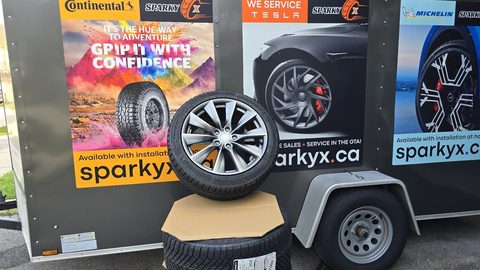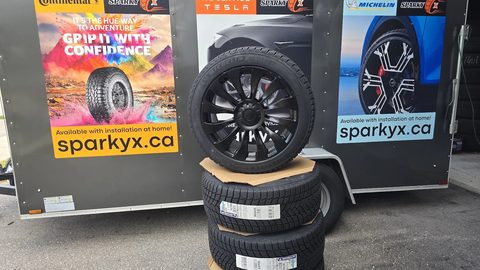

Your Tesla is wearing its winter tires. The wheels are torqued, the pressures are set, and the car drives fine. There is still one job left, and it takes about ten seconds on the touchscreen: tell the car you swapped. Buried in the service menu is a tire setting most GTA owners have never opened, and leaving it on the wrong choice means the car keeps thinking, estimating and calibrating for a tire it is no longer wearing.
Toronto started today at about minus 3, feeling closer to minus 8 in the wind, with rain moving in Thursday and Friday and overnight lows hovering near freezing. That freeze-thaw stretch is exactly when this setting matters — cold mornings, wet roads, and a car that should know what is actually touching the pavement. Here is what the setting does, where to find it, and the three checks that go with it.
Where the setting lives
On the touchscreen, go to Controls, then Service, then Wheel and Tire, then Tires. There you can tell the car which tires are fitted — summer, all-season or winter, depending on what your model shows. After a seasonal swap, set it to winter. Do the same menu again in the spring when the winter set comes off, and after a rotation if the car asks you to confirm the configuration.
It feels like a label. It is not. Tesla uses that selection as an input. The car adjusts how it interprets the new tires while it relearns them, and its range and consumption estimates can better reflect a winter tire, which rolls differently from the summer or all-season tire it replaced. A winter compound, deeper tread and — on a downsized winter package — a different wheel diameter all change what the car should expect from each rotation of the wheel.
Why regenerative braking can feel off after a swap
The complaint we hear most after a Tesla winter swap is not noise or vibration. It is this: the car feels different when I lift off. Regenerative braking can feel weaker or less familiar for a while after the tires change, because the car is recalibrating to new grip, a new compound and sometimes a new overall diameter. Telling the car it is on winter tires speeds up that recalibration instead of leaving it to figure the change out slowly on its own.
That matters in this week's weather. One-pedal driving on a cold, wet Thursday road in Toronto is not the moment you want the car's braking feel mid-relearn. Set the tire type when the swap happens, drive normally, and let the calibration finish on your regular routes. We covered the driving side of this in regenerative braking on ice, and the range side in EV winter range loss explained through tires.
Downsized winters make the setting even more important
Many GTA Tesla owners downsize for winter — a Model Y that summers on 19s or 20s often winters on 18s, with a taller sidewall and a narrower contact patch that cuts through slush better. We explain the logic in downsizing winter tires. When the wheel and tire combination changes, the Wheel and Tire menu is also where the wheel configuration belongs, so the car's speed, distance and consumption math is built on the setup that is actually fitted.
Get that wrong and the small errors stack up quietly: estimates that never quite match the road, a car calibrated for the wrong rolling package, and an owner who assumes the winter tires themselves are the problem. Most of the time the tires are fine. The menu just never got the news.
The pressure check that goes with it
A tire swap in November is not finished until pressures are checked cold — after the car has sat for at least three hours, before driving warms the tires. Tesla's own guidance is that tires lose about 1 psi for every 6-degree Celsius drop in outside temperature. Do the math on this week: a car set correctly in a mild spell can be several psi low by a minus-8 wind-chill morning, without leaking a thing.
Use the number on the Tire and Loading Information label on the driver's door pillar — that label outranks the maximum printed on the tire sidewall, and it outranks any chart on the internet. For most Model 3 and Model Y cars that number is 42 psi cold, front and rear, but your own label is the authority for your car. If the low-pressure warning does appear, treat it as a floor, not a target: by the time it lights, a tire is already well below where it should be. Our guide to the TPMS light in cold weather walks through what to do next.
One exception: the 2026 Model Y Standard
If your winter package conversation includes sensors, know which system your car actually has. Most Teslas read pressure from sensors in each wheel, and Sparky X Tesla packages include pre-programmed Bluetooth TPMS that the car learns as you drive — sometimes patiently, as we explain in why Tesla package sensors take time to wake. The 2026 Model Y Standard is the exception: it uses indirect TPMS, estimating pressure from wheel-speed data instead of in-wheel sensors, which we covered in Tesla deleted the TPMS sensors on the 2026 Model Y Standard. Either way, the tire-type setting still applies — the car still needs to know it is on winters.
The 60-second post-swap checklist
Run through this once, in the driveway, the day the winters go on. First, Controls, Service, Wheel and Tire, Tires: winter selected. Second, pressures checked cold against the door-pillar label, not the sidewall maximum. Third, look at each winter tire's sidewall for the three-peak mountain snowflake symbol — the tested severe-snow rating, not just an M+S marking. Fourth, book the re-torque in your head now: wheels get re-checked after roughly the first 50 kilometres of driving, a habit we detail in re-torque wheels after a tire change. Four checks, about a minute, and the car and the tires are finally on the same page.
How Sparky X can help
Sparky X is a fully mobile tire shop, so your winter set is fitted in your driveway or at your workplace — no shop trip across the GTA. Verified winter options are in the tire and wheel shop, complete setups are on the tire and wheel packages page — packages include free mobile installation, and Tesla packages include pre-programmed Bluetooth TPMS — and Tesla-specific help lives on the Tesla tire service page. Current offers sit on the tire rebates page, the full service list is on the services page, and booking is on the mobile tire service bookings page. Sparky X serves Toronto, the GTA, Durham and York. Our office is at 60 Hoile Drive in Ajax; it is office only, and no vehicle service happens there.
Frequently Asked Questions
Where is the Tesla winter tire setting?
On the touchscreen: Controls, then Service, then Wheel and Tire, then Tires. Select winter after a seasonal swap, and change it back in the spring when the winter set comes off.
What happens if I never change the tire setting?
The car keeps calibrating and estimating for the tire it thinks is fitted. Regenerative braking can feel unfamiliar for longer, and range and consumption estimates can stay based on the wrong tire. The car still drives — it just learns the swap slowly instead of being told.
What pressure should my Tesla winters run?
The pressure on the Tire and Loading Information label on the driver's door pillar, checked cold after the car has sat for at least three hours. For most Model 3 and Model Y cars that is 42 psi front and rear, but your own label is the authority. Expect about 1 psi of loss for every 6-degree Celsius temperature drop.
Does the 2026 Model Y Standard need this setting too?
Yes. That model uses indirect TPMS with no in-wheel sensors, but the tire-type selection still tells the car it is running winter tires, so its calibration and estimates reflect the set that is actually fitted.
The bottom line
A winter swap is hardware and software. The hardware is the tires, wheels, torque and pressure. The software is one menu: Controls, Service, Wheel and Tire, Tires — winter. Toronto is heading into a rainy, near-freezing stretch where grip and braking feel change day to day. Take the ten seconds, tell the car what it is wearing, and let everything downstream — calibration, estimates and warnings — work from the truth.
Want a Tesla winter package fitted at home, sensors and settings handled? Book online and we will come to you.
Book online: sparkyx.ca/book
Call or text: (647) 819-0490
Sparky X Mobile Tire Shop — fully mobile across Toronto, the GTA, Durham and York. Our office is at 60 Hoile Drive in Ajax; all service happens at your home or workplace. We come to you.