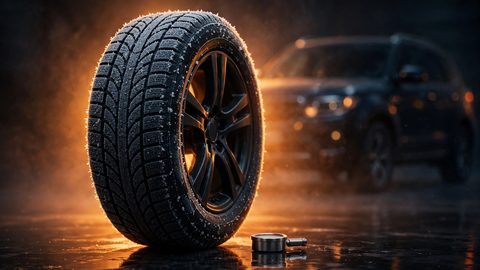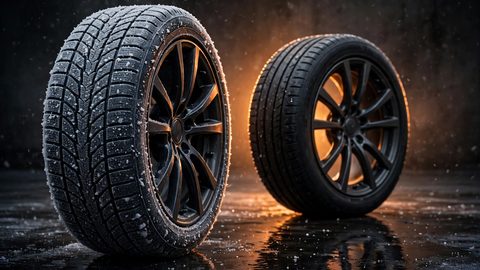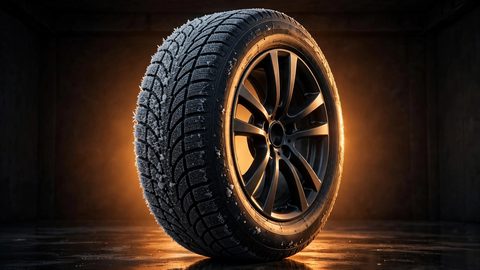

Look at the sidewall of almost any all-season tire in a GTA driveway and you will find two small letters: M+S. Mud and snow. It sounds like a winter rating. It reads like a winter rating. Drivers point to it every fall and say the same thing: my tires are already marked for snow, so I am covered. They are not. M+S was never a winter test, and believing it is one is the myth that puts good drivers on bad tires.
Toronto woke up to about minus 2 this morning with snow showers, a high near 3 today, and a clear night dropping below zero again. That is exactly the weather where this myth bites: cold pavement, a dusting of snow, and a tire whose compound has already started to stiffen. Here is what M+S actually means, what the snowflake symbol actually proves, and how to check your own sidewall in under a minute.
What M+S really is: a tread description, not a test
M+S stands for mud and snow, and it is based on the shape of the tread, not on how the tire performs in winter. A tire earns the marking from its tread geometry — the proportion of grooves and the angle of the tread pattern. There is no snow traction test to pass, no braking measurement on ice, and no cold-temperature compound requirement behind those two letters.
That is why you will find M+S on tires that have no business on a January road in Scarborough or Etobicoke. Plenty of summer-leaning and mild all-season tires carry it. The marking tells you the tread has voids that can move some loose material. It tells you nothing about whether the rubber stays flexible at minus 10, whether the tire can stop on packed snow, or whether it can steer on ice. A description is not a certification, and treating it like one is where the trouble starts.
What the snowflake actually proves
The three-peak mountain snowflake symbol — a mountain outline with a snowflake inside it, molded into the sidewall — is different in kind, not just in degree. A tire only gets that symbol by passing a standardized severe-snow traction test: it has to pull away on medium-packed snow measurably better than a standard reference tire. It is a performance threshold, tested, not a tread description.
Transport Canada points drivers to that symbol for winter use for a reason. When you see the snowflake, you know the tire was built and verified for severe snow service. When you see only M+S, you know nothing of the sort. Our winter tire buying guide for Toronto drivers puts the snowflake check first for the same reason, and our guide to how to read your tire size and load index shows you where each sidewall marking lives so you can find both in seconds.
The cold problem M+S never mentions
Even if the tread pattern were the whole story, winter grip is mostly a compound story. All-season rubber is tuned for mild weather, long life and quiet running. As temperatures fall toward and below about 7 degrees, that compound stiffens. Stiff tread blocks flex less, grip less, and take longer to stop — first on cold dry pavement, then much more noticeably on snow and ice.
A winter tire uses a softer compound designed to stay pliable in deep cold, paired with dense siping — the thin slits that open up thousands of extra biting edges. An all-weather tire is the middle path: a year-round compound that stays flexible in the cold and carries the snowflake because it passed the snow test. We break that three-way choice down in all-weather versus winter tires. What none of those categories share with a plain M+S all-season is a promise about cold. M+S makes no promise at all.
But my M+S tires got me through last winter
This is the part of the myth that keeps it alive. Yes, a careful driver on M+S all-seasons can get through a mild GTA winter, especially on plowed arterial roads in daylight. Surviving a season is not the same as having grip when it counts. Winter tires earn their keep in the worst ten minutes of the season: the unplowed side street at night, the polished intersection on black ice, the sudden stop when traffic on the 401 compresses in falling snow.
In those moments the difference is not tread branding. It is a flexible compound and a tested snow rating versus a stiffening compound and a geometry label. The same logic applies to the drivers who lean on their drivetrain instead — we covered that in AWD does not replace winter tires in Ontario. Four driven wheels help you get moving. Only tires that grip can help you stop and turn, and M+S does not certify that grip.
The one-minute sidewall check
You do not need a shop visit to settle this. Park, turn the front wheels out, and read one front sidewall. First, find the three-peak mountain snowflake symbol. If it is there, your tires are severe-snow rated — winter or all-weather — and the next checks are tread depth and pressure. If the snowflake is not there, keep reading the sidewall. If all you find is M+S, your tires are not winter rated, no matter how aggressive the tread looks or how new they are.
While you are there, check two more things. Look at tread depth: winter tires need real depth to clear slush and bite snow, and Transport Canada guidance treats about 4 millimetres as the winter floor, well before the legal wear limit. Then check pressures cold against the driver-door placard, not the maximum on the sidewall — pressure falls roughly 1 to 2 psi for every 10-degree Celsius drop, and this week has already swung through that range. A snowflake-rated tire that is bald or underinflated is still a compromised tire.
What to do if you only have M+S
If your sidewall check ends at M+S, the honest options are two. Fit a dedicated winter set with the snowflake for the cold months — the strongest choice for drivers who commute in the dark, drive unplowed side streets, or head north of the city. Or, if one set all year genuinely fits your life, choose an all-weather tire that carries the snowflake and accept its winter limits with your eyes open. What does not work is renaming an untested all-season as a winter tire because of two letters.
Timing matters too. This morning already brought snow showers at minus 2, and nights this week stay below zero. Shops and mobile installers book out as soon as the first real snowfall lands, and the drivers who checked their sidewalls in November are not the ones queueing in a storm. A one-minute check today is the cheapest winter decision you will make all season.
How Sparky X can help
Sparky X is a fully mobile tire shop, so your winter set is fitted in your driveway or at your workplace — no shop trip on the wrong tires. Verified winter and all-weather options are in the tire and wheel shop, complete setups are on the tire and wheel packages page — packages include free mobile installation, and Tesla packages include pre-programmed Bluetooth TPMS — and current offers sit on the tire rebates page. The full service list is on the services page, booking is on the mobile tire service bookings page, and common questions are answered in the FAQs. Sparky X serves Toronto, the GTA, Durham and York. Our office is at 60 Hoile Drive in Ajax; it is office only, and no vehicle service happens there.
Frequently Asked Questions
Does M+S mean a tire is rated for winter?
No. M+S describes the tread pattern — its groove geometry for mud and light snow. There is no snow traction test, no ice braking test and no cold-compound requirement behind the marking. A tire can carry M+S and still have no tested winter performance at all.
What does the three-peak mountain snowflake actually test?
It certifies severe-snow traction. To carry the symbol, a tire must pass a standardized test pulling away on medium-packed snow, beating a reference tire by a set margin. That tested threshold — not a tread description — is why Transport Canada points drivers to the snowflake for winter use.
My all-season tires have M+S and lots of tread. Am I fine below zero?
Tread depth alone does not fix the cold problem. Below about 7 degrees, all-season compounds stiffen and lose grip, first on cold dry pavement and then far more on snow and ice. Deep tread on a stiff compound still stops and steers worse than a winter-rated tire in the cold.
Do all-weather tires count as winter tires?
A genuine all-weather tire carries the three-peak mountain snowflake symbol, which means it passed the severe-snow test and can stay on the car all year. Check the symbol on the sidewall rather than trusting the words all-weather or four-season on a label — the symbol is the proof.
The bottom line
M+S is a tread description. The snowflake is a tested winter rating. They are not two names for the same thing, and the difference shows up exactly when you can least afford it — on a cold night, on an unplowed street, in a sudden stop. Toronto started today at minus 2 with snow showers. Take one minute, read your sidewall, and believe the snowflake — not the letters.
Want winter-rated tires fitted at home? Book online and we will come to you.
Book online: sparkyx.ca/book
Call or text: (647) 819-0490
Sparky X Mobile Tire Shop — fully mobile across Toronto, the GTA, Durham and York. Our office is at 60 Hoile Drive in Ajax; all service happens at your home or workplace. We come to you.