
Tire Load Ratings & Capacity
A clear guide to what the Load Index means, how it differs from Load Range (C/D/E), and what to do after a puncture repair—written for real-world service.
1) Load Index (LI): what it means
The Load Index is the maximum weight a single tire can carry at its specified max cold inflation, under lab conditions.
Example: 235/45R18 94V → 94 = 670 kg (1,477 lb) per tire.
Rules of thumb
Replacement tires must have Load Index ≥ the vehicle placard requirement.
Do not “down-load.” Never install a lower LI than placard.
LI is per tire; the axle’s support = LI of each tire × number of tires on that axle.
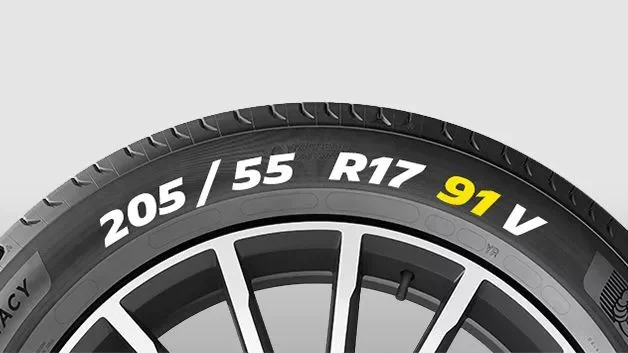
Example tire load index rating 91 - Michelin tire sidewall.
2) SL vs. XL vs. LT — don’t mix them blindly
P-metric Passenger (SL / XL)
SL (Standard Load): typically up to ~35 psi max.
XL (Extra Load / Reinforced): higher max pressure (often 41–50 psi) → more load capacity at a given size.
Keep all tires on an axle the same type (all SL or all XL).
LT-metric (Light Truck) with Load Range
Marked C / D / E (old “ply rating” language). Typical max cold pressures: C 50 psi, D 65 psi, E 80 psi (check sidewall).
Service description often shows single/dual capacity (e.g., 121/118R = higher load when used single vs. dual).
ST (Trailer) & commercial sizes follow their own standards—don’t fit them on passenger vehicles.
3) Inflation, temperature & real capacity
Load capacity is tied to cold inflation pressure. Under-inflation is the #1 cause of overload failure.
Set pressures to the door-placard (vehicle spec).
Expect roughly ~1 psi drop per ~6 °C temperature decrease and adjust seasonally.
Higher speed and heat reduce a tire’s ability to carry load; never exceed limits.
4) After a puncture repair (TIA/USTMA-compliant)
A proper plug-patch from the inside (tread area only, size/spacing within limits) returns the tire to everyday service, but we do not recommend severe service (heavy loads + sustained high speed).
If you routinely carry heavy loads or drive at high sustained speeds, replace rather than rely on a repaired casing.
Never repair sidewall/shoulder or oversized injuries; replace.
5) Plus-sizing & wheel changes
When changing rim size or tire model:
Match overall diameter within ~3% and keep Load Index ≥ placard.
Many low-profile “performance” sizes have lower LI—double-check before ordering.
For cross-overs/SUVs/EVs, XL fitments are common; don’t drop to SL if the placard calls for XL.
6) Quick method to verify capacity
Read the placard (driver door jamb).
Ensure the new tire’s LI number is the same or higher.
Keep axle sets uniform (all SL or all XL; same LI).
Set pressures to placard, re-check next morning cold.
Load Index Table (common passenger/SUV values)
Load Index → Maximum Load (each tire)
| Load Index | kg | lb |
|---|---|---|
| 84 | 500 | 1102 |
| 85 | 515 | 1135 |
| 86 | 530 | 1168 |
| 87 | 545 | 1201 |
| 88 | 560 | 1235 |
| 89 | 580 | 1279 |
| 90 | 600 | 1323 |
| 91 | 615 | 1356 |
| 92 | 630 | 1389 |
| 93 | 650 | 1433 |
| 94 | 670 | 1477 |
| 95 | 690 | 1521 |
| 96 | 710 | 1565 |
| 97 | 730 | 1609 |
| 98 | 750 | 1653 |
| 99 | 775 | 1709 |
| 100 | 800 | 1764 |
| 101 | 825 | 1819 |
| 102 | 850 | 1874 |
| 103 | 875 | 1929 |
| 104 | 900 | 1984 |
| 105 | 925 | 2039 |
| 106 | 950 | 2094 |
| 107 | 975 | 2149 |
| 108 | 1000 | 2205 |
| 109 | 1030 | 2271 |
| 110 | 1060 | 2337 |
| 111 | 1090 | 2403 |
| 112 | 1120 | 2469 |
| 113 | 1150 | 2535 |
| 114 | 1180 | 2601 |
| 115 | 1215 | 2679 |
| 116 | 1250 | 2756 |
| 117 | 1285 | 2833 |
| 118 | 1320 | 2910 |
| 119 | 1360 | 2998 |
| 120 | 1400 | 3086 |
Values are per tire at the tire’s rated max cold pressure (standard charts). Always meet or exceed your vehicle placard’s required Load Index.
LT Load Range quick reference
| LT Load Range | Old “Ply” Term | Typical Max Cold PSI* | Notes |
|---|---|---|---|
| C | 6-ply | 50 | Light truck/cargo use |
| D | 8-ply | 65 | Higher capacity |
| E | 10-ply | 80 | Heavy service |
*Exact pressure/capacity vary by tire—follow the sidewall and vehicle placard.
Why book with Sparky X Mobile Tire Shop
We verify Load Index, service description (single/dual), SL/XL or Load Range, and set placard pressures—then finish with TIA RIST torque and TPMS service. If a casing is punctured or borderline for your load needs, we’ll give you straight guidance on repair vs. replace and can supply, mount/balance, and install on-site.
