
Tire Speed Ratings & What Changes After a Tire Repair
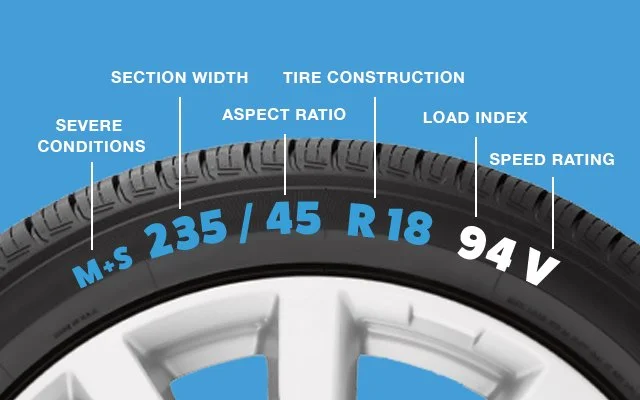
Example of speed rating on the sidewall of a tire: “V”.
1) What is speed rating On Tires?
A speed rating (speed symbol) is the maximum speed a tire can sustain under controlled lab conditions when properly inflated and loaded. It is not permission to exceed posted limits, and it assumes the tire is undamaged, new, and correctly maintained.
Common speed symbols (passenger & CUV/SUV)
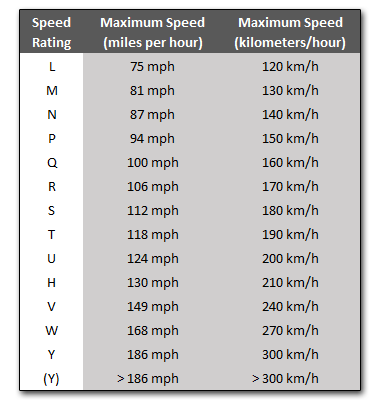
Sample tire speed rating chart.
Tire Speed Ratings — Passenger & CUV/SUV
| Symbol | Max km/h | Max mph | Notes |
|---|---|---|---|
| L | 120 | 75 | Some winter / ST trailer |
| M | 130 | 81 | |
| N | 140 | 87 | |
| P | 150 | 93 | |
| Q | 160 | 99 | Common on winter/LT |
| R | 170 | 106 | |
| S | 180 | 112 | |
| T | 190 | 118 | Common all-season |
| H | 210 | 130 | Performance touring / many EVs |
| V | 240 | 149 | Performance |
| W | 270 | 168 | UHP |
| Y | 300 | 186 | UHP |
| (ZR) | >240 | >149 | Legacy marking; check service description for W/Y |
Ratings are lab-derived and assume an undamaged tire, proper load & cold inflation. After a puncture repair (TIA/USTMA-compliant plug-patch), treat the tire as not intended for high-speed service; consider replacement for H/V/W/Y and EV applications.
2) TIA/USTMA fundamentals for a proper repair
A tire is repairable only when ALL of the following are true:
Damage is in the crown (tread) area only; no shoulder or sidewall damage.
Injury size is ≤ 6 mm (1/4") for passenger and ≤ 6–8 mm depending on LT construction/manufacturer guidance.
There’s no run-flat damage (innerliner/plies overheated or abraded).
A plug-patch (stem + patch) combination is installed from the inside after the tire is removed and inspected. String “plugs” alone are not permanent repairs.
The injury is not overlapped with another repair and respects minimum spacing (typically ≥ 2× injury diameter).
A new valve core/cap is installed; TPMS service kit replaced when applicable.
Final assembly is balanced and set to placard pressure.
If any condition fails, TIA/USTMA consider the tire non-repairable → replace.
3) What happens to the speed rating after a repair?
The conservative, TIA-aligned position
Once a tire has been punctured and repaired, its original speed rating should be considered no longer valid.
The tire may still be serviceable for everyday driving, but it is not intended for high-speed service.
Practical guidance we follow at Sparky X
We treat repaired tires as “non-speed-rated” for performance use.
For customers who routinely travel at sustained highway speeds, a replacement is the safest choice—especially for H/V/W/Y/ZR tires, EV fitments, and low-profile sizes.
If a customer chooses to continue using a properly repaired tire, we recommend:
Obey posted speed limits and avoid sustained high-speed operation.
Re-check cold pressure and the repair area after 24 hours and again at 1 week.
Replace the tire if high-speed or track use is anticipated.
Why so strict? The repair introduces changes to the innerliner and carcass. While a correct plug-patch restores air retention, it does not re-create the original, tested condition used to certify the tire’s speed rating.
4) Special cases
Multiple repairs: Even if individually acceptable, multiple injuries further reduce the tire’s margin for heat buildup at speed. Prefer replacement on performance/EV fitments.
Run-flat (RFT) tires: Many RFTs are not repairable once driven low/flat; manufacturer inspection criteria apply. When a repair is permitted, treat speed rating as void.
LT-metric/All-terrain tires: Many carry lower speed symbols. After repair, treat as non-speed-rated for heavy loads or long highway hauls—monitor temperature and pressure closely.
Ultra-High Performance (W/Y/ZR): Any puncture → best practice is replacement. If repaired per TIA, use for local/legal speeds only; no track or Vmax testing.
EVs (e.g., Tesla): Higher curb weight and torque increase heat and load on repaired casings. We strongly favor replacement for H and above on EVs.
5) How we repair (summary of steps)
Dismount & inspect inside/out: innerliner scuffing, ply separations, bead/shoulder damage.
Prepare the injury: mark, drill/ream on-angle to clean cords, buff innerliner, vacuum dust.
Apply chemicals: inner liner cleaner → vulcanizing cement; install combination unit (plug-patch) from inside.
Stitch the patch, trim stem flush at tread, seal buffed area with innerliner sealer.
Reassemble with new valve core/cap (and TPMS kit if needed), inflate in trajectory-safe position.
Balance, set placard pressure, and document the repair.
6) Customer checklist after a repair
Drive gently for the first 24 hours; avoid high speeds and heavy loads.
Check pressure next morning cold; re-check weekly for a month.
Watch for vibration or pull; return immediately if present.
Plan to replace the repaired tire earlier if your driving includes sustained higher-speed highway travel.
7) FAQ
Q: Does a proper repair make the tire “like new”?
A: No. It restores air retention and everyday serviceability, but not the original speed rating or as-new heat tolerance.Q: Can I use an external plug until I get to you?
A: An external plug is a temporary emergency measure only. It is not an acceptable permanent repair per TIA/USTMA. Get a proper internal repair ASAP.Q: Is sealant OK?
A: Avoid aerosol sealants; they contaminate the innerliner and can prevent a correct repair. Some sealants also damage TPMS.Q: What about treadwear warranty after a repair?
A: Most manufacturers still honor treadwear terms when the repair is TIA/USTMA-compliant and the tire remains within spec. Damage-related warranties are separate.
8) Sparky X Mobile Tire Shop — our policy
TIA/USTMA-aligned inspection and combination plug-patch procedures.
No repairs in shoulder/sidewall or for injuries beyond size/spacing limits.
Speed rating treated as void after any repair; we recommend replacement for performance/EV applications or any sustained high-speed use.
Full TPMS service, calibrated torque (TIA RIST), and post-repair support.
Need a second opinion on a damaged tire or want a same-day mobile replacement instead of a repair? We’ll bring the tire, mount/balance on site, and keep you moving—safely.
